Now we know their names
Comments
-
eggcream wrote: and the next president of the US should know how many freaking states there are in the US. Without his portable teleprompter the guy is an idiot.
Jesus, are you still using THAT old attack? What's wrong, can't find anything new to bash Obama for?
“Over the last 15 months, we’ve traveled to every corner of the United States. I’ve now been in 57 states? I think one left to go.” -
transplant wrote: [quote=LongTimeSloper]
Yes, sarcasm is fun for all, but do you have any idea how much it would cost to fund a national, universal health care system that actually works? A hell of a lot more than a trillion dollars.And again, I really wish you, or any other of the people posting on here, could tell me where the money would come from to fund this "universal healthcare."
Gee, I bet all the money that has been spent on the most recent war would have funded a universal healthcare program rather nicely. what has the government spent? A trillion dollars?
Just making the point that the government finds money for things they want, such as the war. and, that money could have been put to MUCH better use! i am against the war, yet, my tax dollars are going to fund it. -
transplant wrote: I don't need healthcare at the moment, so I'd prefer to save my money for when I do, not have the government steal it to pay for other people's health care, on the vague assurance that when I do actually need health care, the system will still be functioning well enought to provide it.
then why do you have health insurance at all? why don't you do something else with your $50/paycheck, which is currently being spent for the healthcare of other people insured by that company? -
GREAT BITAIN Percentage of Gross Domestic Product (GDP) spent on health care: 8.3
Average family premium: None; funded by taxation.
Co-payments: None for most services; some co-pays for dental care, eyeglasses and 5 percent of prescriptions. Young people and the elderly are exempt from all drug co-pays.
What is it? The British system is "socialized medicine" because the government both provides and pays for health care. Britons pay taxes for health care, and the government-run National Health Service (NHS) distributes those funds to health care providers. Hospital doctors are paid salaries. General practitioners (GPs), who run private practices, are paid based on the number of patients they see. A small number of specialists work outside the NHS and see private-pay patients.
How does it work? Because the system is funded through taxes, administrative costs are low; there are no bills to collect or claims to review. Patients have a "medical home" in their GP, who also serves as a gatekeeper to the rest of the system; patients must see their GP before going to a specialist. GPs, who are paid extra for keeping their patients healthy, are instrumental in preventive care, an area in which Britain is a world leader.
What are the concerns? The stereotype of socialized medicine -- long waits and limited choice -- still has some truth. In response, the British government has instituted reforms to help make care more competitive and give patients more choice. Hospitals now compete for NHS funds distributed by local Primary Care Trusts, and starting in April 2008 patients are able to choose where they want to be treated for many procedures.
JAPAN Percentage of GDP spent on health care: 8
Average family premium: $280 per month, with employers paying more than half.
Co-payments: 30 percent of the cost of a procedure, but the total amount paid in a month is capped according to income.
What is it? Japan uses a "social insurance" system in which all citizens are required to have health insurance, either through their work or purchased from a nonprofit, community-based plan. Those who can't afford the premiums receive public assistance. Most health insurance is private; doctors and almost all hospitals are in the private sector.
How does it work? Japan boasts some of the best health statistics in the world, no doubt due in part to the Japanese diet and lifestyle. Unlike the U.K., there are no gatekeepers; the Japanese can go to any specialist when and as often as they like. Every two years the Ministry of Health negotiates with physicians to set the price for every procedure. This helps keeps costs down.
What are the concerns? In fact, Japan has been so successful at keeping costs down that Japan now spends too little on health care; half of the hospitals in Japan are operating in the red. Having no gatekeepers means there's no check on how often the Japanese use health care, and patients may lack a medical home.
GERMANY Percentage of GDP spent on health care: 10.7
Average family premium: $750 per month; premiums are pegged to patients' income.
Co-payments: 10 euros ($15) every three months; some patients, like pregnant women, are exempt.
What is it? Germany, like Japan, uses a social insurance model. In fact, Germany is the birthplace of social insurance, which dates back to Chancellor Otto von Bismarck. But unlike the Japanese, who get insurance from work or are assigned to a community fund, Germans are free to buy their insurance from one of more than 200 private, nonprofit "sickness funds." As in Japan, the poor receive public assistance to pay their premiums.
How does it work? Sickness funds are nonprofit and cannot deny coverage based on preexisting conditions; they compete with each other for members, and fund managers are paid based on the size of their enrollments. Like Japan, Germany is a single-payment system, but instead of the government negotiating the prices, the sickness funds bargain with doctors as a group. Germans can go straight to a specialist without first seeing a gatekeeper doctor, but they may pay a higher co-pay if they do.
What are the concerns? The single-payment system leaves some German doctors feeling underpaid. A family doctor in Germany makes about two-thirds as much as he or she would in America. (Then again, German doctors pay much less for malpractice insurance, and many attend medical school for free.) Germany also lets the richest 10 percent opt out of the sickness funds in favor of U.S.-style for-profit insurance. These patients are generally seen more quickly by doctors, because the for-profit insurers pay doctors more than the sickness funds.
TAIWAN Percentage GDP spent on health care: 6.3
Average family premium: $650 per year for a family for four.
Co-payments: 20 percent of the cost of drugs, up to $6.50; up to $7 for outpatient care; $1.80 for dental and traditional Chinese medicine. There are exemptions for major diseases, childbirth, preventive services, and for the poor, veterans, and children.
What is it? Taiwan adopted a "National Health Insurance" model in 1995 after studying other countries' systems. Like Japan and Germany, all citizens must have insurance, but there is only one, government-run insurer. Working people pay premiums split with their employers; others pay flat rates with government help; and some groups, like the poor and veterans, are fully subsidized. The resulting system is similar to Canada's -- and the U.S. Medicare program.
How does it work? Taiwan's new health system extended insurance to the 40 percent of the population that lacked it while actually decreasing the growth of health care spending. The Taiwanese can see any doctor without a referral. Every citizen has a smart card, which is used to store his or her medical history and bill the national insurer. The system also helps public health officials monitor standards and effect policy changes nationwide. Thanks to this use of technology and the country's single insurer, Taiwan's health care system has the lowest administrative costs in the world.
What are the concerns? Like Japan, Taiwan's system is not taking in enough money to cover the medical care it provides. The problem is compounded by politics, because it is up to Taiwan's parliament to approve an increase in insurance premiums, which it has only done once since the program was enacted.
SWITZERLAND Percentage of GDP spent on health care: 11.6
Average monthly family premium: $750, paid entirely by consumers; there are government subsidies for low-income citizens.
Co-payments: 10 percent of the cost of services, up to $420 per year.
What is it? The Swiss system is social insurance like in Japan and Germany, voted in by a national referendum in 1994. Switzerland didn't have far to go to achieve universal coverage; 95 percent of the population already had voluntary insurance when the law was passed. All citizens are required to have coverage; those not covered were automatically assigned to a company. The government provides assistance to those who can't afford the premiums.
How does it work? The Swiss example shows that universal coverage is possible, even in a highly capitalist nation with powerful insurance and pharmaceutical industries. Insurance companies are not allowed to make a profit on basic care and are prohibited from cherry-picking only young and healthy applicants. They can make money on supplemental insurance, however. As in Germany, the insurers negotiate with providers to set standard prices for services, but drug prices are set by the government.
What are the concerns? The Swiss system is the second most expensive in the world -- but it's still far cheaper than U.S. health care. Drug prices are still slightly higher than in other European nations, and even then the discounts may be subsidized by the more expensive U.S. market, where some Swiss drug companies make one-third of their profits. In general, the Swiss do not have gatekeeper doctors, although some insurance plans require them or give a discount to consumers who use them.
U.S.A. GPD on health care...15.3%
Transplant,
I don't want my taxes paying for your bullshit wars. You want to live in the Wild West and have no contact with any type of civilization. Our taxes pay for the way we live. Hey did you know that our police departments, our fire departments, our libraries are socialized. Did you know that the way the military operates, not only in funding but in routine are socialism as well. The fact that you are only as strong as your weakest?
Go move to the woods let your brain rot there. -
transplant wrote: One of you, anyone in here, please: Tell me why the government should be able to take my money in order to pay for the health care of other people?
Because we're not animals. Because we're not assholes. Because we live in the wealthiest and most tech advanced nation in the world and because we have the resources and the wealth to take care of our own. The US is still mostly great because in large part we avoid the problems of other huge nations - we don't have countless hundreds of thousands or millions of children and poor people dying of starvation and disease in our streets. We're not beset w/ beggar families pleading for change. We in large don't step over the dead and dying on our way to and from work. Working people and rich people as a matter of course aren't kidnapped by desperate criminals or corrupt policeman who work for a pittance.
We pay for the healthcare, education, well-being of others, firefighters, police, national parks, space stations etc because its the right thing to do. And again, we can afford it.
If the choice is between you, a working person - healthy and employed - having 100 bucks less in your pocket and some kid - old person, or even some shiftless slacker who's never worked a day in their life, being able to eat or find shelter or learn to read and write - then you pony up. If you make 250K+ - you can afford to pay even thousands of dollars more in taxes. Especially in time of crisis. You're among the wealthiest people on the Earth - no one's gonna cry for you.
Moving a strange family of 8 into your 1 bedroom apt - that's socialism. Taking your mountain bike and giving it to some other guy because the government thinks he needs it more - that's socialism.
Kicking in your fair share or even moreso if you can swing it so that your fellow countrymen and by extension your country don't fall off a cliff - that's just the smart and decent thing to do. -
Do you want your tax dollars paying for someone elses house burning down? Some innocent bystander being mugged or shot? How about when the firefighters ran into the Twin Towers to rescue people trapped? Do you want your tax dollars paying for that? How about speeding tickets? Crazy drivers affect you, so do sick people. What is the difference when trying to run a society between health and safety?
-
transplant wrote: Oh, and booklaw? Give me one credible stat that shows that Republicans are more "comfortable" than Democrats. It's not a question of being comfortable or smug. Liberals are the walking personification of "smug." It's a question of not wanting to have your hard-earned money stolen by the government to be given to people who didn't earn it in the most inefficient and wasteful way possible.
According to Pew Research, October 23, 2008, Republicans earn an average of $18,000/yr more than Democrats. 37% characterize themselves as "very happy," compared with only 25% of Democrats. The survey period was 10/3-10/19, which included really bad McCain poll numbers and the collapse of the stock market. You would think they wouldn't be so smug. Not only that, they have always been happier, since Pew started keeping track in the early 70s.
Some factors?Well, Republicans are different from Democrats. How so? Let us count the ways.
http://pewresearch.org/pubs/1005/republicans-happier
* They have more money.2
* They have more friends.3
* They are more religious.4
* They are healthier.5
* They are more likely to be married.6
* They like their communities better.7
* They like their jobs more.8
* They are more satisfied with their family life.9
* They like the weather better.10
* They have fewer financial worries.11
* They're more likely to see themselves doing better in life than their parents did.12
* They're more likely to feel that individuals - rather than outside forces - control their own success or failure.13
* They have more of what they most value in life. (No, it's not money).14
All of these differences are associated with the partisan happiness gap. But a word of caution: It can get very tricky trying to disentangle causes from effects. Even though happiness research has become a cottage industry in recent years, no one has yet been able to nail down all the factors that explain the persistent -- and growing -- Republican happiness advantage.
An interesting survey that I read recently, which I can't seem to find at this moment, had some apropos stats as well. It had to do with attitudes by income level, cross referenced by political party. Basically, it found that poor Republicans generally had hope and believed that if they worked hard, they would ultimately be wealthy and content. Poor Democrats generally had no hope, and believed the the government/society/etc. had done them wrong, and that they would never be wealthy or content. Not surprising, I suppose, but it was interesting to see in black and white. -
daver wrote: An interesting survey that I read recently, which I can't seem to find at this moment, had some apropos stats as well. It had to do with attitudes by income level, cross referenced by political party. Basically, it found that poor Republicans generally had hope and believed that if they worked hard, they would ultimately be wealthy and content. Poor Democrats generally had no hope, and believed the the government/society/etc. had done them wrong, and that they would never be wealthy or content. Not surprising, I suppose, but it was interesting to see in black and white.
Found it.Pro-Government Conservatives and Disadvantaged Democrats have similar socioeconomic backgrounds and confront many of the same financial struggles. Both groups are predominantly female, both are relatively poor, and large majorities in both groups express dissatisfaction with their financial circumstances.
http://people-press.org/report/?pageid=945
But these groups have strikingly different outlooks on their lives and possibilities that go a long way toward explaining the differences in their political attitudes. Feelings about the power of the individual are a major factor in this division. Pro-Government Conservatives are defined, at least in part, by their optimism in this area. About three-quarters (76%) believe that most people can get ahead if they are willing to work hard and two-thirds (66%) strongly express that view. An even higher percentage of Pro-Government Conservatives (81%) say that everyone has it in his or her own power to succeed.
Disadvantaged Democrats have a gloomier outlook. Just 14% think that people can get ahead by working hard; 79% say that hard work is no guarantee of success, and 76% express that view strongly. Only 44% of Disadvantaged Democrats say that everyone has the power to succeed, while slightly more (47%) take the fatalistic view that success in life is determined by forces outside one's own control. -
Thank you, Daver. I had intuited some of that, but had no proof.
-
Disillusionment is great! Just like listening to Reagan, everything is fine,
-
transplant wrote: [quote=brooklynpotter]transplant, if by "afforable healthcare" you mean healthy new york, that's basically not healthcare at all. i had it, i ran through the benefits in 5 months. healthy new york is essentially a plan for healthy new yorkers
No, I don't mean healthy new york. I mean the health insurance that millions of Americans are able to afford, be it through their employer, or however else they pay for it. Yes, you're right, it's not affordable for everyone, and that's unfortunate, but quality health care is a finite resource. It would be great if everyone could eat gourmet meals every night too, but that costs money, because gourmet meals take extensive training to prepare, and are therefore expensive. Medical training is also very expensive and time-consuming, and it's therefore not available to everyone. I feel like I shouldn't have to explain the laws of supply and demand to an adult.
I'm sorry for your personal troubles, but I don't understand why you think the government has the right to take my money to pay for your health care.
this is likely one of the most patronizing things anyone here has written.
sweet tea answered it better than i did, so i'll let her continue my arguments. -
transplant wrote:
of course, no one is going to cry for the people doing well, doing the things a person is supposed to do on the laurels that make this a great country. you know those people that bust their asses and hardly see their families because they are working crazy hours and flying all over the country.
If the choice is between you, a working person - healthy and employed - having 100 bucks less in your pocket and some kid - old person, or even some shiftless slacker who's never worked a day in their life, being able to eat or find shelter or learn to read and write - then you pony up. If you make 250K+ - you can afford to pay even thousands of dollars more in taxes. Especially in time of crisis. You're among the wealthiest people on the Earth - no one's gonna cry for you.
how can you say that $1,000 doesn't mean something to someone? who the hell are you to say what a person should do with their money. i'm sure you have some disposable income you can throw my way then, huh? even it's $5, i'll take it. is it really going to put that much of a dent in your pocket? how about $5 a month? keep it coming!!!! i'll use it for my kid's education.
thanks!!! -
I'm coming into the thread realllll late here, but I couldn't resist the bait.
transplant wrote: One of you, anyone in here, please: Tell me why the government should be able to take my money in order to pay for the health care of other people?
Excuse me for being an idealistic fool here, but as has been said, so long as our government is able to take MY money in order to pay for the "death care" of other people around the world under the guise of "national defense", I will maintain that at least as much should be spent on the health care of our very own people here.
Instead, just more than HALF of all our taxes goes toward military spending alone. And on top of that, THAT money equals more than HALF of the military spending of the entire planet. Yes, we spend more money on "national defense" than every other nation on earth does, combined.
All for a country that hasn't been attacked by another nation since 1941. (and I'm not pretending 9/11 wasn't a big deal; it just wasn't (and still isn't) anything that all the military in the world could have prevented)
There's just no excuse that a nation as rich and relatively safe as ours should spend such a disproportionate amount on military when things that kinda sorta matter for our own future -- education, health -- get absolutely shafted.
-
transplant wrote: One of you, anyone in here, please: Tell me why the government should be able to take my money in order to pay for the health care of other people?
It may have been said earlier in this thread. but i think that you do not understand the concept of government.
Why do you believe the government should NOT be able to take your money to pay for the health care of other people?
Do you oppose all taxation, or just taxes that go towards programs you don't agree with? Because your argument could be turned to any government program and would have just as much validity. Just substitute, education, clean air and water, research funding, regulatory agencies (I don;t eat meat so why should I pay taxes to make sure other people's meat is safe?)
In addition, even if you opposed government spending for healthcare, you are really only opposing it for some people. The government already provides healthcare for the poor and elderly through medicare and medicaid, veterans through VA hospitals, (as wonderful as they are) and children through various state run programs.
In a sense, we already have socialized medicine in this country. Emergency rooms cannot deny someone care even if they have no ability to pay. Whenthat happens we all end up paying and our taxes are used even less efficiently than if someone was able to get a simple checkup that kept them healthy to begin with. -
your passions have reached Gothamist. http://gothamist.com/2008/10/28/mccain_1.php#comments
-
transplant wrote: brooklypotter - You can argue semantics all you want, but if you're basing your voting decision on whether or not a candidate would allow abortions or not, and based on that rational, you're supporting the pro-abortion candidate, then you're pro-abortion.
Not being anti-abortion does NOT mean someone is pro-abortion... I don't know anyone who is FOR abortions. I know people who don't want the government to tell them that they can not have an abortion if they so chose to get one done. -
Stella wrote: [quote=transplant]brooklypotter - You can argue semantics all you want, but if you're basing your voting decision on whether or not a candidate would allow abortions or not, and based on that rational, you're supporting the pro-abortion candidate, then you're pro-abortion.
Not being anti-abortion does NOT mean someone is pro-abortion... I don't know anyone who is FOR abortions. I know people who don't want the government to tell them that they can not have an abortion if they so chose to get one done.
pro-life or anti-abortion are both misnomers. The more accurate label is compulsory childbirth. -
metalnyc wrote: of course, no one is going to cry for the people doing well, doing the things a person is supposed to do on the laurels that make this a great country. you know those people that bust their asses and hardly see their families because they are working crazy hours and flying all over the country.
Taxation and government spending are not a personal affront/attack to you and your family.
how can you say that $1,000 doesn't mean something to someone? who the hell are you to say what a person should do with their money. i'm sure you have some disposable income you can throw my way then, huh? even it's $5, i'll take it. is it really going to put that much of a dent in your pocket? how about $5 a month? keep it coming!!!! i'll use it for my kid's education.
thanks!!!
When it comes to taxes there are 3 types of people – those earning enough that they can pay more and not be thrown into a catastrophic pit of ruin – those earning just enough that they are right on the brink pit – and those who earn nothing or next to nothing. Taxing the last group is a moot point – there’s nothing there to tax. Taxing the second group is cruel and stupid. They’re barely eking by and are just one paycheck or car accident or faulty water heater away from homelessness and ruin. Once ruined and homeless it now falls to the government (funded by our taxes) to protect, feed and clothe them (as the government should because that’s the sort of country I want to live in). That leaves the first group.
Yes they’ve earned their money and they should be proud of their accomplishments. But at the proposed levels of income – $250K+ (and that really income level puts you fuck far away from the ruin pit) - that $1000 bucks you’re so outraged about is not a matter of life and death. It just isn’t. Again it sucks that they have to cough it up and yes there’s a lot they can do w/ that $1000 bucks – but we’re crazy deep in debt and we have to fix it now. That $1000 means a lot to those who are asked to give it up - I’m not saying it’s meaningless – I’m saying the country needs it desperately and you alone ($250k+ people) are in the position to pay it.
We’ve put off the debt for years and it just makes things worse. I’d rather my kid mature into a time of economic surplus and robust health rather than inherit my bullshit. And even if I didn’t have kids or would never have kids, I would still think it’s a dick move to saddle today’s kids with our bullshit. I didn’t create the mess we’re in but I find myself saddled w/ the responsibility to try and clean it up. Not being a world leader or world shaker – my small role in all of this bullshit is to kick extra tax money into the kitty and hope/insist that the next administration actually does their job of governing wisely and eradicating that disgusting debt that we are all saddled with.
If everything works the way it’s supposed to, I shouldn’t need to give you $5 for your kid’s education. If your kid needs an education then the amount of money I’m paying through taxes should be enough to provide for your kid and anybody else’s kid who wants an education.
I believe that Charity giving (of which the US has always been the world’s leader) and the organizations (secular and religious) that have sprung up to help our fellow citizens in need, are a clear sign that our government isn’t doing its job. Again our taxes and the government we elect and set up to manage our affairs – should be doing just that. Any charitable donations should, in a perfect US, be exclusively for the needy of other nations. The US should not have needy citizens. -
possibly_maybe wrote: Instead, just more than HALF of all our taxes goes toward military spending alone.
Source? The Center on Budget and Policy Priorities says that it is 21%. FWIW.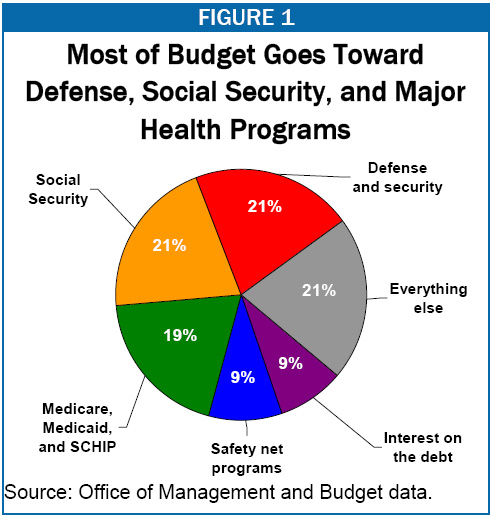
Defense and security: In 2006, some 21 percent of the budget, or $557 billion, went to pay for defense, homeland security, and security-related international activities. While more than $100 billion went to support operations in Iraq and Afghanistan, the bulk of spending in this category reflects the underlying costs of the Department of Defense and other security-related services.
http://www.cbpp.org/4-10-07tax2.htm
That said, I have seen studies that put the military figure into the 40s or beyond, they typically do this by fudging numbers and incorporating pieces of debt interest and other services into the military figure. Feel free to post yer source so that I can pick at it.possibly_maybe wrote: And on top of that, THAT money equals more than HALF of the military spending of the entire planet. Yes, we spend more money on "national defense" than every other nation on earth does, combined.
Source? The Center for Arms Control and Non-Proliferation, which is rathered biased anyhow, puts the figure at 48%. US Defense spending has been on a steep curve since 9/11, but then so have many other countries. Typical charts that I have seen that tower the US as more than half of all spending do so by using future budget numbers or projections for the US, while using 2004-2008 real numbers for the other countries. Check out the curve on China's defense spending if you want scary, they put us to shame in terms of the uptick. Also, compare defense spending by percentage of GDP, and you will find the US typically within the same ballpark as many other countries. The Middle East, North Korea, parts of Africa, well, they are a totally different ballpark as they spend MUCH more. -
> If you make 250K+ - you can afford to pay even thousands of dollars more in taxes.
This quote is scary. Yes, the government pays for many differnent types of social services and welfare programs already...with our taxes. But the line of what should and should not be paid by Uncle Sam is a delicate balance which is not to be taken lightly. Ever hear of the slippery slope? If you follow the logic in the above quote through to the end, you end up with a government resembling something more like the USSR that than the USA.
Maybe those rich people can't afford to pay thousands more in taxes. Because they buy stuff. Maybe they have a yacht. Maybe they have 3 homes. So should the government come in and say "you don't need that yacht" - fork it over? I play bass and spend a decent amount of my money on equipment. Should the governement tell me I can't buy a bass because I'm over some kind of spending limit? Who sets that limit? What is the limit? Does it differ depending on where you live because of cost of living?
The government's most important function is to protect our borders and provide safety within our borders. So it makes perfect sense to me for most of our taxes to go towards defense spending. Next important function is to provide our infrastructure. I think that government healthcare should be treated like any other welfare program. People that are in dire straits should get government healthcare and anyone who is capable of paying for their own (whether privately or through an employer) should do so. If the government is paying for everyone's healthcare, why shouldn't they pay for everyone's houses? And food? etc etc etc -
BoogieKnight wrote:
i don't believe $250k is a lot of money in NYC. even in a decent neighborhood, a 3 bedroom is a lot of money. so take your mortgage for a 3 bedroom, a car (maybe 2), day-to-day living and commuting expenses, where does that leave you for savings and/or personal wants?
Yes they’ve earned their money and they should be proud of their accomplishments. But at the proposed levels of income – $250K+ (and that really income level puts you fuck far away from the ruin pit) - that $1000 bucks you’re so outraged about is not a matter of life and death. It just isn’t. Again it sucks that they have to cough it up and yes there’s a lot they can do w/ that $1000 bucks – but we’re crazy deep in debt and we have to fix it now. That $1000 means a lot to those who are asked to give it up - I’m not saying it’s meaningless – I’m saying the country needs it desperately and you alone ($250k+ people) are in the position to pay it.
as willregistersoon said above, who decides? -
The government's most important function is to protect our borders and provide safety within our borders. So it makes perfect sense to me for most of our taxes to go towards defense spending.
This might be the most important function of the government, if we were surrounded on all sides by enemies attempting to invade and to subjugate us. As it is, it is nothing but total nonsense.
You could cut out all expenditures for the Iraq war... every single penny... and our borders would be no less safe.
Most of our "defense" spending is actually "offense" spending... intended to maintain or increase our ability to fight wars outsideof our borders.
Is that really more important than feeding, educating and maintaining the health of all of our children? Not to me! -
metalnyc wrote: [quote=BoogieKnight]
i don't believe $250k is a lot of money in NYC. even in a decent neighborhood, a 3 bedroom is a lot of money. so take your mortgage for a 3 bedroom, a car (maybe 2), day-to-day living and commuting expenses, where does that leave you for savings and/or personal wants?
Yes they’ve earned their money and they should be proud of their accomplishments. But at the proposed levels of income – $250K+ (and that really income level puts you fuck far away from the ruin pit) - that $1000 bucks you’re so outraged about is not a matter of life and death. It just isn’t. Again it sucks that they have to cough it up and yes there’s a lot they can do w/ that $1000 bucks – but we’re crazy deep in debt and we have to fix it now. That $1000 means a lot to those who are asked to give it up - I’m not saying it’s meaningless – I’m saying the country needs it desperately and you alone ($250k+ people) are in the position to pay it.
as willregistersoon said above, who decides?
And this is what divides most people when voting, income levels. To me and my family, $250k per year is a lot of money. We don't even come close to making that and we live in a good neighborhood, have a large apartment, pay a mortgage, have children, etc. etc. And, yes, I firmly believe people who make more money should be taxed at a higher level. -
willregistersoon wrote: > If you make 250K+ - you can afford to pay even thousands of dollars more in taxes.
Basically, I have a fundamental disagreement with metalnyc and apparently you Will. I really have no problem with paying a percentage of income as tax. I think that it is fair for people to pay a percentage of their income. Metalnyc (and others I suppose) believe instead that everyone should pay a set amount. Say $20k. I think that making a single mother of four earning $25k pay $20k in taxes the same as a fly single guy bringing home $1M is unfair. You think that making that single mom pay, say, $5k (20%) while making the guy pay $200k (20%) is unfair. Why should he have to pay $200k while she pays $5k? I answer why should she have to pay 80% of her income while he pays 2%? We are at an impasse. I have nothing for you.
This quote is scary. -SNIP-
Maybe those rich people can't afford to pay thousands more in taxes. -
LongTimeSloper wrote: [quote=metalnyc][quote=BoogieKnight]
i don't believe $250k is a lot of money in NYC. even in a decent neighborhood, a 3 bedroom is a lot of money. so take your mortgage for a 3 bedroom, a car (maybe 2), day-to-day living and commuting expenses, where does that leave you for savings and/or personal wants?
Yes they’ve earned their money and they should be proud of their accomplishments. But at the proposed levels of income – $250K+ (and that really income level puts you fuck far away from the ruin pit) - that $1000 bucks you’re so outraged about is not a matter of life and death. It just isn’t. Again it sucks that they have to cough it up and yes there’s a lot they can do w/ that $1000 bucks – but we’re crazy deep in debt and we have to fix it now. That $1000 means a lot to those who are asked to give it up - I’m not saying it’s meaningless – I’m saying the country needs it desperately and you alone ($250k+ people) are in the position to pay it.
as willregistersoon said above, who decides?
And this is what divides most people when voting, income levels. To me and my family, $250k per year is a lot of money. We don't even come close to making that and we live in a good neighborhood, have a large apartment, pay a mortgage, have children, etc. etc. And, yes, I firmly believe people who make more money should be taxed at a higher level.
ok, i'm not asking your age or exactly how long you have been a a Long Time Sloper, but imagine being about 30 years old and starting a family and trying to buy that 3 bedroom and having a couple of kids. the ratio between salaries and real estate isn't exactly fair in this fine city, so that's why i believe $250k is not a lot in this day and age. If you bought a 3 bedroom 20 years ago and it cost you $200 - $300k, then yes, $250k leaves you with some disposable income, but when a 3 bedroom is upwards of $1mil, it doesn't. -
booklaw wrote: You could cut out all expenditures for the Iraq war... every single penny... and our borders would be no less safe.
Add Afghanistan to Iraq and you still will be struggling to reach 20% of the defense budget, which would be 4% of the total budget. *shrug* -
metalnyc wrote: imagine being about 30 years old and starting a family and trying to buy that 3 bedroom and having a couple of kids. the ratio between salaries and real estate isn't exactly fair in this fine city, so that's why i believe $250k is not a lot in this day and age. If you bought a 3 bedroom 20 years ago and it cost you $200 - $300k, then yes, $250k leaves you with some disposable income, but when a 3 bedroom is upwards of $1mil, it doesn't.
OK, lets call it a cool mill. For fun. You really ought save 20% down, so that would be $200k. You get a 30yr fixed mortgage for the remaining $800k, that would put your payment around $5,400. Going from the other direction, tax rate on $250k/yr is 33%, leaving you $167,500, which is about $14k/mo. Deduct your mortgage and you have $8,600/mo left. Now I realize that there are a number of things that still need to come out of there, but it really isn't dire straights. -
Daver - I don't know where you got that example, but I never said people should pay a flat dollar amount regardless of income. That's ludicrous. Of course it should be by percentage - and I even believe it should be a graduated percentage - as it is today. Already as it is, the system is slanted so that the rich pay more. I had this discussion with an uncle of mine, and went to an indepenant tax think tank group and found some stats. I don't remember the exact numbers, but the top richest 1% of the country, take on about 40% of the country's tax burden. The top 5% is like 60% of the burden. It already is somewhat socialistic as someone pointed out.
The problem I have is that politicans like to use the tax policy to get votes. They say they want to lower taxes, and where do they keep going to get the money? The evil rich of course. This is the slippery slope. Where does it end? -
willregistersoon wrote: Daver - I don't know where you got that example, but I never said people should pay a flat dollar amount regardless of income. That's ludicrous. Of course it should be by percentage - and I even believe it should be a graduated percentage - as it is today. Already as it is, the system is slanted so that the rich pay more. I had this discussion with an uncle of mine, and went to an indepenant tax think tank group and found some stats. I don't remember the exact numbers, but the top richest 1% of the country, take on about 40% of the country's tax burden. The top 5% is like 60% of the burden. It already is somewhat socialistic as someone pointed out.
OK, you don't believe what metalnyc does then. Yay you. Of course the richest 1% are going to pay most of the taxes, that is how percentages work. Alternatively, we could go communist and everyone could pay the same rate AND the same amount, right?
The problem I have is that politicans like to use the tax policy to get votes. They say they want to lower taxes, and where do they keep going to get the money? The evil rich of course. This is the slippery slope. Where does it end?
BTW- FYI neither McCain nor Obama propose increasing tax rates on anyone. McCain proposes extending the temporary rate cuts put in by Bush, Obama proposes allowing them to expire for the two highest categories. In no case should anyone be paying more than they did in the 90s, in fact, everyone should be paying less. Where is this slippery slope of which you speak? -
daver wrote: [quote=metalnyc]imagine being about 30 years old and starting a family and trying to buy that 3 bedroom and having a couple of kids. the ratio between salaries and real estate isn't exactly fair in this fine city, so that's why i believe $250k is not a lot in this day and age. If you bought a 3 bedroom 20 years ago and it cost you $200 - $300k, then yes, $250k leaves you with some disposable income, but when a 3 bedroom is upwards of $1mil, it doesn't.
OK, lets call it a cool mill. For fun. You really ought save 20% down, so that would be $200k. You get a 30yr fixed mortgage for the remaining $800k, that would put your payment around $5,400. Going from the other direction, tax rate on $250k/yr is 33%, leaving you $167,500, which is about $14k/mo. Deduct your mortgage and you have $8,600/mo left. Now I realize that there are a number of things that still need to come out of there, but it really isn't dire straights.
yup, there are other deductions like State, City, SS, SUTA/FUTA that also bring the gross down a good amount. no one is saying at $250k you are in dire straights, but people are equating $250k to being rich and in this city it's no where near being rich, it's being comfortable. and apparently being comfortable isn't allowed due to other's misfortunes.



Howdy, Stranger!
Categories
- 40K All Categories
- 27.1K Neighborhoods
- 5.1K Crown Heights/Prospect Lefferts Gardens
- 7.1K Prospect Heights
- 2.3K Fort Greene, Clinton Hill, Bed-Stuy
- 8K Park Slope
- 549 Williamsburg, Greenpoint, Bushwick
- 442 Flatbush/Midwood/Ditmas Park
- 657 BoCoCa (Boerum Hill, Cobble Hill, Carroll Gardens)
- 151 Red Hook
- 104 Gowanus
- 304 Bay Ridge/Bensonhurst
- 130 Coney Island, Brighton Beach, Sheepshead Bay
- 270 Brooklyn Heights, DUMBO and Downtown
- 598 Windsor Terrace / Kensington
- 673 Greenwood Heights and Sunset Park
- 749 Brooklyn and Beyond
- 6.3K Stuff
- 86 Brooklyn Back When
- 1.2K Brooklyn Pets
- 257 Brooklyn Kids
- 241 Brooklyn Eats
- 51 Brooklyn Booze
- 3.6K The Lounge / Random Stuff
- 611 Brooklyn Politics
- 122 Brooklyn Sports and Fitness
- 111 Brooklyn Photos
- 339 Site Issues
- 8 Frequently Asked Questions (FAQ)
- 6.2K Listings
- 1.1K APARTMENTS and REAL ESTATE
- 1.3K Sales Openings Events
- 2.3K The Classifieds