Mr Obama aka Bush 2.0 are you ever gonna cut the defense budget?

thanks jerkwad.
Comments
-
Do you think it's easy?
Do you think it's what the American public wants?
-
Every few years (working together with other entities) the Pentagon puts out a list of bases it believes should be closed.
http://www.brac.gov/finalreport.html
And very few of the recommendations are ever followed because the states don't want to close bases that are percevied as vital to local economies.
Pork, the other white meat.
-
Armchair, care to respond to my questions?
-
Funny thing how today we see so many people calling themselves ''libertarian''. Yet these same people who call themselves so principled fail to demand that the military industrial complex be shut down, all foreign military bases closed, and the Pentagon be dissolved. After all, these things are in conformance with libertarian principles.
For once I'd like to see these people stand up and demand these things.
-
While I agree that the military is a bit out of control, if we're gonna speak from a budgetary stance it's probably the least of our problems...
But if we were to talk about the elephants in the room, people would get upset. "HOW DARE YOU SUGGEST RAISING SS ENTITLEMENT AGE A YEAR, DESPITE PEOPLE LIVING AND WORKING SIGNIFICANTLY LONGER THAN WHEN THE PROGRAM AND ORIGINAL AGES WERE CREATED/CHOSEN". Lol. Kills me
-
But if we were to talk about the elephants in the room, people would get upset. "HOW DARE YOU SUGGEST RAISING SS ENTITLEMENT AGE A YEAR, DESPITE PEOPLE LIVING AND WORKING SIGNIFICANTLY LONGER THAN WHEN THE PROGRAM AND ORIGINAL AGES WERE CREATED/CHOSEN".
It's not that simple though. Defense spending is up there with SS, even if it's not AS big.
So we could cut defense spending, or we could cut SS, which helps millions of Americans that might need it to survive. Usually poor/working class/middle class Americans.
-
It's not that simple though. Defense spending is up there with SS, even if it's not AS big.
So we could cut defense spending, or we could cut SS, which helps millions of Americans that might need it to survive. Usually poor/working class/middle class Americans.
Nowhere in the post you quoted did I suggest cutting SS. Just making necessary changes and adaptations to make it sustainable. As is it's not. Pls don't try to answer questions of logic with vague emotional appeals. I don't want anyone to starve, but at the same time the country shouldn't go broke trying to feed people. When the US govt is forced to default after continuing to take on more promises, every American loses.
Defense can get cut but again it's not defense that seems to be at the forefront of programs that will bankrupt the country.
-
you said we should raise the retirement age, isn't that cutting SS coverage?
Defense can get cut but again it's not defense that seems to be at the forefront of programs that will bankrupt the country.
Defense is 20%, almost identical to Social Security and Medicare/caid

http://www.cbpp.org/cms/index.cfm?fa=view&id=1258
Pls don't try to answer questions of logic with vague emotional appeals.
That's a poor oversimplification of a point I'm fully willing to discuss. I think the idea that "let's raise the retirment age" and other suggestions w/r/t SS/Medicare is putting the burden on the poor & middle classes, rather than looking elsewhere also.
Realisitically, all of the big ticket items need to be evaluated, and taxes on the richest 1% need to be raised dramatically.
But no politician will ever propose those things, and Americans have convinced themselves they don't want it anyway.
-
Why is cutting MC/SS out of the question, but raising taxes on the rich an "absolute need"?
Ties back into my previous questions on what is acceptable as an American standard of living, and how responsible the gov't is in ensuring that every American has it, along with the costs we as a country are willing to pay to ensure that everyone gets to live a certain way.
Everyone has to pay their part. I have never said we shouldn't re-evaluate American tax structure or that things aren't skewed one way or another. But I think it's hypocritical to say programs helping one group are absolutely off the table for discussion, but programs to take more from other groups are mandatory.
Again I ask... why is it so wrong to even consider raising the SS entitlement age? People are starting work later and living longer. SS original parameters did not factor in those things and as a result the costs have gone up. Is it really that terrible of an idea?
-
There are other SS reforms that could happen, but the cynic in me says they would be a disaster.
For example, those on the right favor privatizing social security because it would allow people to escape a rapidly sinking program. Here's their speech:
http://www.socialsecurityreform.org/problem/index.cfm
Basically they argue that the system will soon become a way in which income is redistributed from the working to the non-working, and they are generally opposed to wealth redistribution in any form
...even to old people who have paid into the system their entire lives, under the belief that it was a saving account.
As we are aware, it is not a savings account at all. It is a pay-as-you-go system, and because there will soon be more recipients than people paying in, both will soon be screwed.
The right proposes that (if given the right incentives) people will save for their own retirement and not rely on the government. By creating such incentives, it can gradually reduce the SS benefits under the theory that "we told you the benefits were going to suck by the time you reduced your retirement age and that you should save money in a some kind of IRA".
While I would love for people to exercise such personal responsibility, the cynic in me looks at how much debt the average american carries on their credit cards and thinks THIS WILL NEVER HAPPEN.
By creating schemes in which people can save money prior to it being taxed by SS, those of us who do save for the future will effectively abandon the system, and the system will be left even more in deficit.
However, because those of us with brains and cash have left, we will block any proposal to rescue it and simply let those that didn't save be subject to ever decreasing benefit levels.
Not even I, a pretty fiscally conservative guy, (and someone who socks away a good % of his paycheck into a 401k) thinks we are going to successfully impart in people the discipline necessary to save for the future.
....and when I turn 65, I really don't want to watch my fellow old people starve even though they didn't listen to my advice by saving. I just don't have in me, and (obviously via politicians) will allow some type of taxpayer program to be created that allows them to live above the TANF (public assistance) level. Call me weak. Call me an enabler. whatever.
So, I have to admit, government should continue to have a role in providing for the old ....even those who could have, and should have, saved but didn't.
But I have no clue how we are going to pay for this incredibly expensive SS program, or how we would cut it because so many people have an ingrained belief and expectation that the government will pay for their retirement. It is a complete mess.
...I'm with CTK, raising the retirement age might be a start.
-
I still like my old idea. Give those who can afford it the choice of paying some minimum SS tax and the ability to save + invest some amt of their income tax free, or pay the full SS tax and get full benefits. Then the people who can't pay in still get their checks, and I get to do more with my money while still fulfilling my obligation to the poor. As is I'm not factoring SS into my retirement... but I'm being charged like I am. Might as well make it another full blown welfare tax.
-
Why is cutting MC/SS out of the question, but raising taxes on the rich an "absolute need"?
Ties back into my previous questions on what is acceptable as an American standard of living, and how responsible the gov't is in ensuring that every American has it, along with the costs we as a country are willing to pay to ensure that everyone gets to live a certain way.
Everyone has to pay their part. I have never said we shouldn't re-evaluate American tax structure or that things aren't skewed one way or another. But I think it's hypocritical to say programs helping one group are absolutely off the table for discussion, but programs to take more from other groups are mandatory.
Again I ask... why is it so wrong to even consider raising the SS entitlement age? People are starting work later and living longer. SS original parameters did not factor in those things and as a result the costs have gone up. Is it really that terrible of an idea?
did you even bother reading what I wrote?:
Realisitically, all of the big ticket items need to be evaluated, and taxes on the richest 1% need to be raised dramatically.
-
SS is rapidly becoming simply a tax.
Today, they lowered the tax. Soon, they will cut the benefits.
-
did you even bother reading what I wrote?:
Realisitically, all of the big ticket items need to be evaluated, and taxes on the richest 1% need to be raised dramatically.
Of course I read it, which is why it was confusing. If there are places where we can cut costs and lower the overall tax burden, why is it an absolute must that taxes on the richest 1% have to be raised dramatically? ESPECIALLY considering there are large swaths of the population generating considerably more income than the minimum deduction that pay little to no taxes at all? The two things are unrelated, and tax hikes on any part of the population that pays them are unwarranted, even at this point in our country's history. If you have a business facing tough times, you don't jack up prices based on income... you figure out ways to cut costs and stay afloat. You stop giving discounts and free stuff to people who don't have as much $$$$ as the fat cats. While the US federal financial situation is more complex than that, the cashflow problem isn't.
I think the more sensible approach is to look at places to cut costs, reevaluate the value of the programs people seem willing to bankrupt the govt to pay for, and look at a progressive tax policy that is simple, fair, collects from everyone (from the bottom to the top) and stops subsidizing behaviors favored by the govt. Even the article you posted agrees:
While critics often decry “government spending,” it is important to look beyond the rhetoric and determine whether the actual public services that government provides are valuable. To the extent that such services are worth paying for, the only way to do so is ultimately with tax revenue. Consequently, when thinking about the costs that taxes impose, it is essential to balance those costs against the benefits the nation receives from public services.
-
While the US federal financial situation is more complex than that, the cashflow problem isn't.
Your metaphor is a non sequitur. The US Gov isn't selling a product in an open market capitalist system, and a govt taxing its citizens isn't the same as making profit off customers. I mean, obviously there's some truth to it, but mostly I think it's misleading.[center]
A starting point my underlying philosophy is this: currently our tax rates for the rich ($1M+ per year) and especially the richest 1%, are at historic lows that are far outside most anything in American history since before the crash in '29.
If we care about deficits and gov financing, raising our historically low taxes on the rich and richest 1% simply has to be a high priority, if not the highest priority.
Govt programs need to be harshly evaluated. Some need to be cut. But our tax code is wildly out of whack given American historical standards as well as what these people gain from our functioning society.
Both things must be considered. (cuts & tax rates)
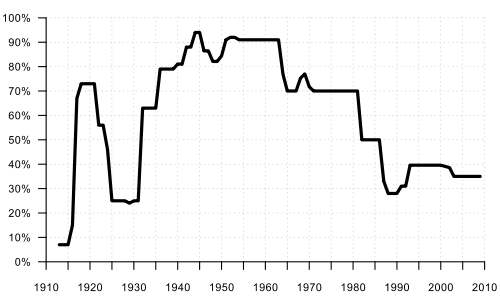
Here is an important figure that illustrates my point.
This is the top marginal tax rate over time. Notice the dramatic nose dive when Reagan takes office, and where we are now.
We could marginally increase taxes on this segment, create a lot more revenue, and still be nowhere near our historical high or even historical median.
-
A starting point my underlying philosophy is this: currently our tax rates for the rich ($1M+ per year) and especially the richest 1%, are at historic lows that are far outside most anything in American history since before the crash in '29.
Yes but their tax rates are still higher than the rest of the population so I'm unsure as to what relevance this has on anything. Remember there are large swaths of the population that have a zero to negative tax burden. What about them?
No... No... NO!!!! I don't want make assumptions but it seems like you have an agenda here... if we care about deficits and gov financing, we should look to eradicate unnecessary cost and make the gov't more efficient. Again I don't claim to know what your deal is but you seem to have an unwarranted hard on for wealth redistribution and an exponential "progressive" tax curve. If you want to punish those who get wealthy at the expense of poor people, make a case for the individuals responsible and stop festering sweeping hatred for the rich. I'm sure you'd be outraged if some fat cat dismissed all people under some economic threshold as entitled freeloaders mooching on society- which is absolutely not true and unfair, and counterproductive to any discussion on how to solve America's problems. We're all citizens of the same country.
If we care about deficits and gov financing, raising our historically low taxes on the rich and richest 1% simply has to be a high priority, if not the highest priority.The bottom line is the gov't should be looking to spend less & tax fairly; not spend more and bleed the rich. The tax code is important but gov't waste & addiction to debt is easily a bigger & more relevant problem. There's absolutely no reason, even in this recession, that our gov't should be working in a deficit. The gov't should be operating in part at least on the interest of its surplus. It's unacceptable IMO
-
my agenda? yeah, my agenda is that you and I have profound philosophical differences on taxation and entitlement programs and how to lower debt.
it's probably more constructive if you admit that rather than arguing from a perspective as if The Truth is objectively on your side by saying things like, "gov't waste & addiction to debt is easily a bigger & more relevant problem."
you call it wealth redistribution, I say tax codes in line with our country's historical standards
you call it punishing the rich, I say make them help support the society that has made them so wealthy
you call it hatred for the rich, I'm offering you a chart and making a rational argument, whether you agree with it or not.
I don't think our taxes on the richest 1% are high enough. That's not hatred. That's not irrational. It's just something you don't agree with. Very big difference between the two.
-
I just don't follow your logic.
my agenda? yeah, my agenda is that you and I have profound philosophical differences on taxation and entitlement programs and how to lower debt.
it's probably more constructive if you admit that rather than arguing from a perspective as if The Truth is objectively on your side by saying things like, "gov't waste & addiction to debt is easily a bigger & more relevant problem."
What's not objective about it? You have yet to demonstrate how taxes being too low (in your opinion) for the top 1% of the population is a detriment to the country. You have yet to even rationalize why their tax rates are too low (despite being higher than most Americans' taxes as a % of their income), and what would constitute a "reasonable" rate for them. You also have yet to outline why we should immediately jump to raising taxes, when the story of the US federal gov't over the last decade has been one of abysmal fiscal policy & mismanagement from both parties. If the gov't can't manage the money it's getting now, where is the logic in prioritizing collecting more taxes over learning how to manage the taxes we already get?
you call it wealth redistribution, I say tax codes in line with our country's historical standards
Based on what? The only tax rate history available goes back to 1913, and in that year the highest federal tax rate was 7%. I guess history is in the eye of the beholder. Maybe you mean the part of American history where the top 1% were getting taxed at 90% by the federal gov't, which ushered in all the tax diversion schemes and shelters that are probably a bigger problem than asinine tax rates.
Not to mention, America is a dynamic country that adapts to change. What's the rationale in arbitrarily looking back solely because tax brackets were higher? Where's the context? What's the imagined fiscal impact? How will that help solve our problems?
you call it punishing the rich, I say make them help support the society that has made them so wealthy
This country has helped to make them wealthy in the same way it's helped you and I to make our livings here. Again can you justify these kinds of statements beyond seemingly arbitrary subjective judgments? These are the people who pay the highest taxes. When it's all said and done, when you combine FICA, SS, MC & local taxes, for someone making a couple million a year the nominal tax rate is well over 50%. I just checked my paycheck today, and my nominal tax rate is close to 40% (and I am nowhere near the top 1% of earners). During the boom, instead of hording all the extra revenue, the gov't STILL spent more than it took in. And you want to give them MORE?you call it hatred for the rich, I'm offering you a chart and making a rational argument, whether you agree with it or not.
I don't see the rationale in raising taxes in any capacity right now. Especially over getting our gov't to be accountable and fiscally sane.I don't think our taxes on the richest 1% are high enough. That's not hatred. That's not irrational. It's just something you don't agree with. Very big difference between the two.
I could see it as being rational if you could offer some rationale for your opinion in the context of how our gov't is performing now, and the REAL nominal tax brackets for ALL Americans after the govts' behavioral tax breaks & income based assistance. I really feel like it's you who doesn't get what I'm saying.IMO, a viewpoint that is driven more by emotion and gut feel than rationale is not a viewpoint worth having. Note, I've never said the tax system is perfect, and I think it needss an overhaul & thorough restructuring from top to bottom (prob for a lot of reasons we wouldn't agree with). But the reality is, fiscal mismanagement is a bigger problem in our gov't than tax distribution. I find it downright puzzling that in you can say some people aren't paying enough taxes, and that some people, who often pay NO taxes despite generating income, aren't being helped enough by the gov't in the same breath. What's your philosophy? If it's not based heavily in contempt for the rich and involuntary wealth distribution then maybe you should clarify.
-
We are aware that CTKs position seems ready for passage by the pres and legislature, right?
If this doesn't represent the intention of the majority in this country, the republicans will be voted out eventually.
Sometimes the populace feels we need a larger government..... Perhaps next election the government will regain the public's trust. Until then, there seem to be a lot of people like CTK who feel they may be the best stewards of their earnings. ....or at least not want to lose any more of it.
-
The questions are:
1. Do we want to have the world's most powerful military?
2. Do we want to be able to send that military into action in various places around the world, simultaneously, and to keep them their for many years?
3. Do we want to provide medical care and social security benefits for persons of a specified age?
4. Do we want to provide medical care, food stamps and other benefits for people living at or below the poverty line, and for their children?
5. Do we want to provide money for scientific, medical and military research, and for tunnels and bridges and highways?If we want any or all of those things, who should pay for it, and should they all pay the same amount, or should they pay on a graduated scale according to income?
CTK seems to think that everyone should pay the same percentage of their income, which of course would mean that no one can be required to pay any significant portion of their income, as everyone includes the poor, who cannot afford to pay a significant portion of their very low income. So the very rich, who could afford to do so, but would rather not, thank you, get off lightly, and even if society were to agree that all of the above-mentioned expenditures are important, there simply would never be enough funds to pay for it all, and we would incur huge deficits.
And that, kiddies, is the story of the Bush tax reductions, in a nutshell.
-
I think there is value in government assistance for the poor & a progressive tax system. I just take issue with the idea of prioritizing tax hikes on an already exponentially progressive tax system by a government that couldn't maintain a surplus in one of the biggest economic booms in history.
I also think it's entirely possible for Americans to get all the things they need from their governments on significantly less $$$ than the gov't is collecting, if we would just hold them accountable and stop enabling pork and convoluted policy.
I also think it's definitely high time for us as Americans to get a functional collective understanding of our gov't, and really critically and objectively evaluate the programs in place, their respective values, and their costs. To me it makes no sense to talk about policy change in a vacuum absent of fiscal impact, when our fiscal mishaps are a huge part of our problems today. Policy talk is meaningless in the context of a bankrupt gov't, and it appears that is where we are headedd
-
Sorry CTK, I missed all the objective proof you showed that we can't raise taxes on the richest 1%. Oh right, you provided none.
It should just be taken for granted that waste is proirity #1 and that raising taxes is a non-starter.
Why? Becuase you said so, duh.
Look, I have my philosophy, you have yours.
If you have questions about various claims, ask and we can discuss. But stop acting like I'm irrational or naive, and that your comments are objectively logical and obvious and require no evidence.
Here is my starting point:
In addition to cutting social services and investigating waste, we need to raise taxes on the wealthiest 1%, closer to historical levels. (FOR REFERENCE OF VARIOUS RATES IN THE 20th CENTURY SEE GRAPH ABOVE).The wealthiest 1% of Americans make 50-60% of the wealth. I think they should be taxed more heavily than they are. This is a philosophical belief.
I understand you disagree, but sadly, your opinion isn't objective truth.
-
It's a big demand to make based solely on faith
Here's my rationalization for my POV- perhaps it seems so sensible to me that I've mistakenly presented it as fact, and for that I apologize.
Less govt waste --> lower gov't costs + more accountable govt --> lower taxes + better gov't for everyone --> no need to raise anyone's taxes, and the possibility of collectively lowering taxes or keeping taxes the same to create a surplus.
My philosophy addresses a lot of the problems plaguing the govt all under one initiative.
What problems does solely raising taxes on the richest 1% resolve?
The govt will still be wasting money.
The govt will still be unaccountable.
The tax system will still be needlessly complex and contain all the loopholes that the wealthy use to get around paying taxes.
There will be even MORE money funneled into an inefficient govt than invested back into an ailing economy (admittedly, much of this money will also probably sit in savings, but I'd rather have some money invested than have all money sink into the federal abyss)You presented a graph of historic tax rates on the 1% bracket. What is the graph's relevance? Are you implying that things were better when tax rates on the top 1% were higher? How were things better? What is it about the higher taxes on the rich that made things better?
Truthfully, I don't think higher taxes are the answer to the worker's utopia you seem to be an advocate for; a volunteering of corporate profits for more pension & welfare programs is. More taxes would just lead to more pork, more war, more corporate welfare and more of everything the gov't is doing that is detrimental to the country, IMO.
So yes, I concede that eliminating waste as a priority is my opinion/philosophy on the best approach to solving many of the country's ills, and I stand behind that. It's not just a philosophy standing on it's own; it's something I've concluded and have been able to, at least for myself, convincingly rationalize. Again I ask, what is the rationale for raising taxes on the top 1%, in the context of the US govt as it operates today?
-
Also I never said we can't raise taxes on the top 1%, I'm just asking why we need to
For example, if you proposed such a tax hike on the rich that could close the deficit (and do nothing more), but through auditing and cost reductions the gov't were able to cut twice as much operating cost from nuking waste, essentially creating a surplus... would you still propose the hike? Is it about fulfilling a budgetary need or addressing some philosophical problem?
-
The government will always waste taxpayer dollars, no matter what. That's because it consists of human beings, all of whom are imperfect.
Some are dishonest.
Others are stupid.
Others are greedy.Others want to impress voters in their home districts.
All know that the money they're spending comes out of other people's pockets, and not their own.
For the above reasons, "cutting out government waste" will never solve our economic problems, unless and until we replace all members and workers of our government with mechanical robots, who lack the imagination and greed to steal and/or waste our money.
So we have to either reduce government programs, or increase tax collections.
The problem with reducing government programs is that no one can agree which programs should be cut, and by how much. Some want to reduce military budgets, others want instead to cut out all welfare plans and throw the poor and the elderly out on the street to die.
At the same time, few people want their taxes raised.
Do we have an ungovernable society, or what?
-
Some want to reduce military budgets, others want instead to cut out all welfare plans and throw the poor and the elderly out on the street to die.
A bit hyperbolic, no? :rolleyes:
And I think there are places of egregious waste, or at least places where we can begin to talk about some compromises, like raising the SS entitlement age. Some may scoff and say it's impossible to consider and such a move to be tantamount to "throwing the poor and elderly out on the street to die". But ultimately, such tough decisions will have to be discussed in language & perceptions bound by reality, and they will be made... or the country will plunge into bankruptcy, lose its reserve currency status, yadda yadda... and that's not hyperbolic
-
And the idea of raising taxes while basically embracing gov't waste is just mind boggling. Maybe I am msising the punchline of some joke here. You don't raise the credit limits for someone who doesn't look like they won't be able to pay it off. You don't give a raise to a poorly performing employee. So I don't see why you would raise taxes to fund an inefficient gov't
-
...without taking a stand on whether we are cutting waste or not, I post the following. Time will tell whether these cuts will result in people "ending up on the street and dying", or if the sector it ends sounding like it did before the 1996 Clinton era welfare reforms.
Readers may recall that some ultra liberals sector screamed that such cuts to welfare would create mass chaos, but seemingly, that didn't happen. (shhh, the ultra liberals don't like to be reminded of these speeches).
I am asking for some artistic license on this post, because the cuts that follow are NYC ones, and (I readily admit) this is a thread about federal taxes.
For simplicity, can we assume these cuts that will be enacted as result of the budget shortfall without caring whether they were federally funded? ...I enter the conversation with the assumption that the federal reductions will effect programs similar to these.
If we choose to entertain my assumption, it would allow us to then discuss whether these cuts are "elimination of waste" or the "elimination of vital government programs".
[I also assume that discussing whether the US needs a new F-35 fighter program is a stretch for most us]
---copied from the New York NonProfit Press---
Council Hears Nonprofit Concerns
on Mayor’s Budget Cuts
The negative impacts of Mayor Bloomberg’s proposed Program to Eliminate the Gap (PEG) cuts to human service programs were highlighted during a round of budget hearings held by the New York City Council on Monday. Advocates and providers presented their concerns in testimony to the Council’s Finance Committee and other committees with jurisdiction over child welfare, youth and senior services, and more.Whether the Council actually has the legal power to stop the Mayor’s November Financial Plan PEG cuts – at least during the current fiscal year – is doubtful. Advocates are hoping that ongoing negotiations, including a series of alternative savings possibilities, may allow some revision in the service cuts.
Senior Services
High on the list of issues were plans to cut senior services, including a reduction of $3.3 million this year and $6.6 million annually beginning next year for case management – an estimated 30% cut.
“The decision to reduce the budget for case management services was indeed a difficult one,” said DFTA Commissioner Lilliam Barrios-Paoli. “DFTA turned to case management for reduction because we felt we could work with CMAs (case management agencies) to restructure the service in a way that would ensure continutity of service to the existing caseload of clients.”
Advocates disagreed. “The impact of the cut will likely be the layoff of 110 highly trained social workers, resulting in over 8,000 seniors either receiving compromised, lower quality services or no services at all,” said advocates in testimony presented jointly by the Council of Senior Centers and Services (CSCS), UJA-Federation of New York, Federation of Protestant Welfare Agencies (FPWA), United Neighborhood Houses (UNH) and the Human Services Council of New York (HSC).
Advocates stressed that the cumulative impact of repeated cuts to the Department for the Aging (DFTA) budget had reached a critical stage. “City funding for the older adult population has substantially eroded; since June 2007 funding for programs administered by the Department for the Aging has been cut by $51 million. This past year, a dangerous new pattern has emerged. The City has begun cutting life-sustaining programs for the near poor, homebound senior population including social adult day care, home care and now, case management.”
Youth Services
The New York City Youth Alliance, a coalition of 14 other provider and advocacy groups, testified in opposition to cuts to Beacon Programs, Discretionary Programs, and Runaway and Homeless Youth (RHY) services.
“Annual funding for each Beacon has remained at the same level for 20 years,” said the group. “The current proposed cut of 10% to Beacon contracts will result in fewer youth served and reduced staff capacity.”
In response to the Mayor’s proposal to reduce RHY drop-in centers and outreach contracts, the Youth Alliance noted that “on any given night there are over 3,800 youth homeless in the city” while a recent report indicated that there were only 113 crisis beds and 122 transitional independent living beds available to NYC homeless youth. “Given the shortage of funds for critical services to the Runaway and Homeless Youth population, this cut needs to be restored.”
The Alliance also took issue with the Mayor’s proposal to cut discretionary youth programs by 5.4%, noting that “Council discretionary funds are the lifeblood of many nonprofit organizations in New York City.”
Child Welfare
The Citizens Committee for Children (CCC) expressed concern about the impact of cuts to the Administration for Children’s Services. “The November Financial Plan seeks to cut ACS’ budget by $24.5 million in FY11 and $36.9 milllion in FY12,” said Stephanie Gendell, CCC’s Associate Executive Director for Policy and Public Affairs. “The number of reports of abuse or neglect investsigated by ACS is at an all-time high and the indication rate remains high, meaning that ACS is continuing to find families where they believe there has been abuse or neglect. On the other hand, fewer children are receiving preventive services and fewer children are in foster care – meaning that many more children and families coming into contact with ACS are not receiving services through ACS.”
City Council General Welfare Committee Chair Annabel Palmer echoed these concerns. “Under the Mayor’s proposed budget, the Administration for Children’s Services is faced with the potential loss of over 250 positions, including 80 Child Protective Specialist Supervisors,” she said. “At the city level, we have much work to do in addressing the looming budget deficit, but we simply cannot risk our children’s right to safety and protection from abuse in the pursuit of austerity.”
Child Care
Advocates also criticized the Mayor’s plan to raise parent fees for children participating ins ubsidized child care from 12% to 17% of adjusted family income and to triple the minimum co-payment from $5 to $15 per week.
“By definition, the Mayor’s plan to raise parent fees for children participating in subsidized child care will have a disproportionate impact on the lowest income families, since 75% of the households receiving subsidized care are below 135% of the federal poverty level,” said Liz Accles, Senior Policy Analyst on Early Childhood Education for FPWA. “Given the high cost of living in New York City, many low income parents are already forced to make difficult choices between providing basic needs such as food, rent, utilities, medicine, and purchasing clothing for growing children. This proposal deepens those burdens,”
Making the Case
Prior to Monday’s hearings advocates had a chance to share their concerns and background information with City Council Committee Chairs and its Finance staff during a meeting last week. “We are very grateful to Speaker Quinn and Finance Director Preston Niblak for the opportunity to brief the Council on potential impacts of these proposed cuts,” said Chris Winward, Senior Policy Analyst at HSC who helped to organize the meeting. “We hope that we will be able to continue to provide the Council with in depth information on the human service sector’s perspectives and concerns in advance of future budget hearings.”
ditto, here's a fee hike that might have the effect of fewer people in poor neighborhoods exercising http://www.nytimes.com/2010/12/08/nyregion/08fees.html?ref=nyregion
...to me, it seems most city rec centers are near NYCHA developments. -
on the subject reducing waste.... It is is often estimated that up to 15% of the charges to medicaid are for services not performed or unnecessary (sometimes this represents fraud, sometimes it represents failure to document work properly, sometimes it stems from tests that are provided merely to cover a MDs butt from a lawsuit ...it is often less risky to over prescribe tests than it is too leave one's butt exposed)
Here's the latest attempt by the NYS gov to tackle Medicaid Fraud, Waste and Abuse.
http://www.omig.ny.gov/data/images/stories/work_plan/omig_work_plan_2010_2011.pdf(wish them luck!)
-
the idea of raising taxes while basically embracing gov't waste is just mind boggling.
I think this is where our philosophies diverge. To make the claim that we can't give the govt more tax revenue b/c it wastes some of what it already has (I think that's a fair summary of your position, if not pls correct me) requires a few assumptions which I'm not convinced are true:
1. there is such a massive amount of waste and fraud that by tackling it you could make a serious dent in the deficit, or find enough money to actually fund decent public schools, or make college more affordable, or make our bridges stop falling apart.
2. such a strategy is at all feasible. I think that's what booklaw is getting at. It is going to be nearly impossible to ever completely eradicate fraud and waste. We're a massive country serving a massive population. So if that is the case, is the solution to just cut services for people, in this case the middle and lower class? That's pretty much the entire Republican platform on the deficit: cut entitlement (for poor/middle class) people.
OR should there be comprehensive reform on everything from accountability to SS/Medicare to defense spending to taxes on the richest 1%.
I vote for that.


Howdy, Stranger!
Categories
- 40K All Categories
- 27.1K Neighborhoods
- 5.1K Crown Heights/Prospect Lefferts Gardens
- 7.1K Prospect Heights
- 2.3K Fort Greene, Clinton Hill, Bed-Stuy
- 8K Park Slope
- 549 Williamsburg, Greenpoint, Bushwick
- 442 Flatbush/Midwood/Ditmas Park
- 657 BoCoCa (Boerum Hill, Cobble Hill, Carroll Gardens)
- 151 Red Hook
- 104 Gowanus
- 304 Bay Ridge/Bensonhurst
- 130 Coney Island, Brighton Beach, Sheepshead Bay
- 270 Brooklyn Heights, DUMBO and Downtown
- 598 Windsor Terrace / Kensington
- 673 Greenwood Heights and Sunset Park
- 749 Brooklyn and Beyond
- 6.3K Stuff
- 86 Brooklyn Back When
- 1.2K Brooklyn Pets
- 257 Brooklyn Kids
- 241 Brooklyn Eats
- 51 Brooklyn Booze
- 3.6K The Lounge / Random Stuff
- 611 Brooklyn Politics
- 122 Brooklyn Sports and Fitness
- 111 Brooklyn Photos
- 339 Site Issues
- 8 Frequently Asked Questions (FAQ)
- 6.2K Listings
- 1.1K APARTMENTS and REAL ESTATE
- 1.3K Sales Openings Events
- 2.3K The Classifieds