SPLIT TOPIC: American society: the poor the unemployed
Comments
-
I agree that taxes pay for the infrastructure of a functioning society. BUT as President Obama noted in his
State of the Union message, we now operate in a global economy and must compete with ALL nations, where wages and taxes are much cheaper than are possible in the US.As CTK pointed out, corporate profits are taxed 2X, at the local and Federal level through corporate tax and through income taxes on dividends.
In the global economy, when taxes are too high, wages are uncompetitive and labor skills sets are available in a cheaper venues. The outsourcing phenomena which started as early as the 1960s. Low skilled jobs are the first to go. NY is already among the states with the highest wages/taxes/cost of living, and has already experienced a
loss of businesses and individuals (& the jobs & taxes that go with them). Is anything actually manufactured in the "garment center"? Were you aware that law firms outsource document review to Mumbai and have relocated senior associates (not partners) to oversee these operations?Further proof: 2010 Census - NY lost Representatives in the House of Representatives, as well as lower tax
revenue due to the exodus.Further government regulation increases the cost of doing
business, providing more incentive to move jobs outside of the country. BTW, wages in meat processing plants were higher for this unskilled labor, because of the unpleasantness of the work, before those jobs were taken by illegal workers willing to work for far less.The bubble/bust in housing & the economy was largely a result of bad laws & regulations, not lack of regulation. If laws mandating banks to make mortgage loans to individuals who did not have the means to own a
home. Greed by the bankers was accompanied by unrealistic expectation of home ownership and irresponsible borrowing by individuals who, but for these laws & regulations, never would have received loans to purchase homes in the
past, because they couldn’t afford them. Government policy distorted the free market with disastrous results. As was stated before, home ownership is a privilege, not a necessity.Homeowner correctly points out that the “Robber Barons” established many charitable institutions and foundations
benefiting the masses. However, their fortunes were largely made before the introduction of the Income Tax. Today’s wealthy must do so while paying igh taxes, with only partial tax deductions. -
Pity the wealthy, whose diligent efforts to emulate the great robber barons are frustrated by those nasty taxes! How terribly unfair it is!
-
Nobody's blaming the poor. Jeez never mind.
-
Geez Booklaw - you extracted that pithy summary from my post? Guess I have to revisit my old grammar school for some additional English classes - oh wait that's closed.
Most of my teachers (if still alive) are probably in Florida enjoying a nice pension thanks to the lucrative contracts extorted by the Teachers Union.What I was trying to point out, as many other posters did, is that the wealthy have the most resources to supplement programs which as administered by the government fall woefully short - yet what is the incentive for the wealthy to do so (please space me the societal obligation speeches). Over-tax the wealthy and they are gone further eroding an already reduced tax base.
As for the wealthy EMULATING anything - I point to the celebutards who only seem to emulate the lowest forms of society with their self-centered, self-destructive and often illegal behavior.
-
Natty - I do not think CTK is mad because he thinks people aren’t trying and/or are making the wrong decisions. I believe his frustration is that people are not taking RESPONSIBILITY for not trying or for making the wrong decisions.
For every person that tries, there is no guarantee of success - but does this warrant not taking the risk of trying at all?
One of my closest friends (and her sister) were regularly mocked for acting/speaking white - Oreo was the common name back then. Who had the last laugh? Both are professionals making well into the six figures. Was the risk of trying and the ridicule they faced worth it? IMO, damn straight.
There are many variables that can waylay even the best thought out plans (the old adage, we plan, God laughs comes to mind) but to not try for fear of failure is the worst possible excuse. Why do you think those trying are ridiculed? Could it be possible that jealousy is a factor? Misery loves company after all.
If you believe that being rich and successful and getting out of the hood is never gonna happen, it never will. You are absolutely correct in pointing out that having a lot of people who think there is no point in trying leads to HUGE problems.
IMO one of the primary problems with education in NYC stems from the teachers union - tenure, unsustainable pension and salary provisions, etc. Teachers who cannot educate (or have lost the drive to do so) cannot be fired. New teachers (with new ideas and ambition) cannot be hired. Salaries are not tied to performance. Part A of the problem. Part B - the emphasis on learning within the home.
Busing and integration was effected in the 1960s where children were "swapped" out of neighborhoods. Net result - kids who were very tired from a long ride TO/FROM school and had to deal with the prejudices of the "local" students. If the teacher at school A was just as unmotivated as the teacher at school B, integration did not accomplish anything. Charter schools appear to be somewhat of a solution - bot notice how the teachers union is vehemently opposed to this concept?
-
BTW - went on the NYC DOE website - here are the salaries:
$45,530 Bachelors degree w/no experience
$51,425 Masters degree w/no experience
%74,796 Masters w/some experience
Avg: $100,049
Note, this is based on a 180 day school year. If the per diem rate was applied to a 261 day work year the salaries would be closer to:
$66,018
$74,566
$108,454
Avg. $145,071
Natty, it does not appear that we getting the value for our tax dollar. Perhaps this would be the first issue to address in the problems of education. -
Domino you touched on reasons for the housing bubble, however you ignored what turned a bubble into one of the biggest financial crises in the history of the world.
Today’s wealthy must do so while paying igh taxes, with only partial tax deductions.
Actually by 20th century standards, the wealthy's taxes are at some of the lowest rates they've ever been.
BTW, wages in meat processing plants were higher for this unskilled labor, because of the unpleasantness of the work, before those jobs were taken by illegal workers willing to work for far less.
Wages were also higher when workers were unionized. Good luck trying to get the workers unionized now so that they'd have a chance at livable wages and reasonable workplace safety.
But maybe the almighty unfettered free market will just take care of that?
Further government regulation increases the cost of doing
business, providing more incentive to move jobs outside of the country.There are a lot of other factors that you're conveniently ignoring. We have the most expensive least efficient health care system of any developed country in the world. It is actually one of the single biggest obstacles to American companies competing in the global marketplace.
-
We are also competing against economies that supplement private investment with massive public investment.
Their governments do not hesitate to use imminent domain.
....allowing the firms that locate there significant advantages.
-
Actually by 20th century standards, the wealthy's taxes are at some of the lowest rates they've ever been.
The rates are lower but the actual percent of the total tax burden they pay is higher (federally anyway).
http://www.taxfoundation.org/news/show/250.html
In 1980 the breakdown was:
Top 1%- 10%; Top 5%- 32%; Top 25%- 56%
2008 it was
Top 1%- 20%; Top 5%- 34%; Top 25%- 67%
The bottom 50% went from contributing 17% to 13% over the same period. Also the total federal tax burden has doubled after inflation (GDP doubled as well). So tax wise, after inflation, the top 1% is contributing 4x what it was 30 years ago (2x more due to doubled GDP, 2x more WRT to the rest of the country).
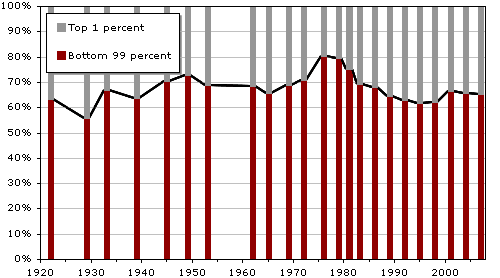
The distribution of wealth, contrary to popular opinion, has not changed much over the past couple of years (or since the beginning of the 20th century for that matter) as far as the relationship between the top 1% & bottom 99% goes
http://sociology.ucsc.edu/whorulesamerica/power/wealth.html
This is not to defend the rich or make the case that they can't give more. Just to stop the spreading of the idea that things have changed so dramatically for the worse for the poor numerically over the past few decades. Like I said the problem isn't in resource allocation as much as it is in ensuring effective use of said resources. Things have been shifting in ways that should benefit the poor, and yet nothing seems to be changing for them positively. It's not a matter of tax or wealth distribution.
-
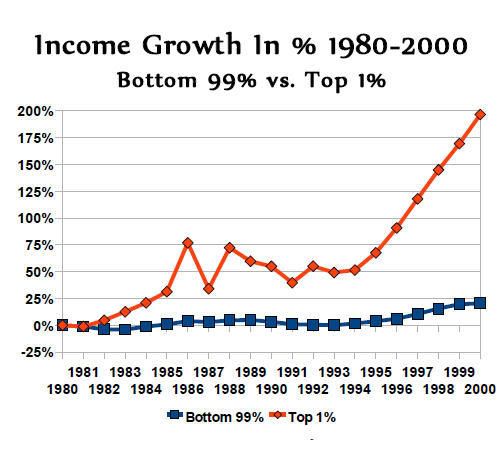
Data that only goes back to the early 80s, when Reagan pretty radically changed the American tax policies, doesn't refute my point about the entirety of the 20th century.
The distribution of wealth, contrary to popular opinion, has not changed much over the past couple of years (or since the beginning of the 20th century for that matter) as far as the relationship between the top 1% & bottom 99% goesI'm not sure what you're basing this claim on.
Wages for the bottom 99% have stayed stagnant for decades, but income for the wealthy has steadily climbed.


http://www.openleft.com/diary/21487/the-failure-of-voodoo-economics-in-pictures
-
BG - are you referring to the mortgage backed securities or derivatives? The underlying cause of all of the above: greed and sense of entitlement by numerous factions.
You also refer to taxation - there was no income tax prior to this past century. What possible measurement could we use to compare to ZERO?
I agree that wages were also higher when workers were unionized - however - if wages are allocated to exorbitant union dues what is the net result to the worker? You indicate that getting the workers unionized would result in liveable wages and workplace safety - my argument is that getting unions in has resulted in the flight of corporation to other global locations. IMO unions are no longer proponents of the union members but of their own bloated bureaucracies and underfunded pension plans. Do you honestly believe that a liveable wage for an assembly line worker at the Detroit Ford plant is $45/hour?
Government regulation may increase the cost of doing business but no more than unions. If workplace safety falls under government regulation - say OSHA - What additional impact does a union have?
I do not have sufficient facts to compare the healthcare systems in Europe (or Canada) to ours. But I have never heard of any person on Medicare denied a hip replacement or being put on a waiting list - yet this is commonplace in the UK.
-
Cool The Kid said:
Actually by 20th century standards, the wealthy's taxes are at some of the lowest rates they've ever been.
The rates are lower but the actual percent of the total tax burden they pay is higher (federally anyway).
http://www.taxfoundation.org/news/show/250.html
In 1980 the breakdown was:
Top 1%- 10%; Top 5%- 32%; Top 25%- 56%
2008 it was
Top 1%- 20%; Top 5%- 34%; Top 25%- 67%
The bottom 50% went from contributing 17% to 13% over the same period. Also the total federal tax burden has doubled after inflation (GDP doubled as well). So tax wise, after inflation, the top 1% is contributing 4x what it was 30 years ago (2x more due to doubled GDP, 2x more WRT to the rest of the country).
The distribution of wealth, contrary to popular opinion, has not changed much over the past couple of years (or since the beginning of the 20th century for that matter) as far as the relationship between the top 1% & bottom 99% goes
http://sociology.ucsc.edu/whorulesamerica/power/wealth.html
This is not to defend the rich or make the case that they can't give more. Just to stop the spreading of the idea that things have changed so dramatically for the worse for the poor numerically over the past few decades. Like I said the problem isn't in resource allocation as much as it is in ensuring effective use of said resources. Things have been shifting in ways that should benefit the poor, and yet nothing seems to be changing for them positively. It's not a matter of tax or wealth distribution.
Just for curiosity's sake, is it possible that, due to the stratosphereic increase in wealth the top upper percent has garnered in the past 20 years (which is fact, not my ramblings - http://www.nytimes.com/2007/12/15/business/15rich.html), the reason that this top percentage now contributes 20% of the tax burden instead of 10% is simply because they hold more liquid assets to tax, while the bottom 50% now hold less than they did 20 years ago? Is it also possible that the avenues in which this top 1% largely managed to amass this much more wealth in the last 20-30 years is due in large part to extreme relaxation in federal regulations, leading to the creation of credit default swaps, CMBS investment pools, etc.?
Which brings up another point... without strong federal regulations in place, you have companies like Goldman Sachs creating large CMBS investment pools made up of crap mortgages that they knew were destined to fail, then marketing said CMBS pools to their own customers as solid, triple A-rated investments, while at the same time hedging, or betting against, the very same CMBS investment pool they were selling to their investors, garnering Goldman windfall profits while their customers lose their shirts.
Over-regulation is indeed terrible, and does in fact hinder smart business growth. Under-regulation, however, leads to nonsense like my above example. There is ahappy medium, but we're not even close yet.
-
booklaw said:
Pity the wealthy, whose diligent efforts to emulate the great robber barons are frustrated by those nasty taxes! How terribly unfair it is!Yep. The wealthy have TRILLIONS sheltered in overseas tax free accounts and there are some who still say the wealthy deserve more of your money:
-
BG - are you referring to the mortgage backed securities or derivatives? The underlying cause of all of the above: greed and sense of entitlement by numerous factions.
People defaulted on their mortgages for a lot of reasons. It brought the financial industry, banking industry, and almost the entire world, to its knees because of unregulated and basically completely-not-understood derivatives and derivatives of derivatives.
John and Jane EastNewYork did not convince Moody's to take piles of worthless mortgages, chop them up, repackage them with a different bow on top, and then all the sudden rate them AAA securities.
John and Jane EastNewYork did not tell Lehman Bros to leverage the firm far beyond any reasonable or rational limit by buying and selling these completely worthless packages.
_ _ _ _
Non unionized meat plant workers make god knows how little per hour. $5? $3? $1? Working in basically unregulated and inhumane working conditions. Do I think workers would prefer that to paying union dues and making at least actual minimum wage?
No, I don't.
I don't really care how it gets done, but workers need to be paid minimum wage and they need reasonable protections. Whether that's achieved by unions or any other means, I don't care. But the current situation is no ok simply b/c we're scared of meat packing getting outsourced to Mexico.
I do not have sufficient facts to compare the healthcare systems in Europe (or Canada) to ours. But I have never heard of any person on Medicare denied a hip replacement or being put on a waiting list - yet this is commonplace in the UK.
Then you haven't done much reading on our health care system costs and inefficiencies and I strongly urge you to do so. Here are two great places to start:
http://www.newyorker.com/reporting/2009/06/01/090601fa_fact_gawande?currentPage=all
http://www.newyorker.com/reporting/2009/12/14/091214fa_fact_gawande?currentPage=all
-
I would just like to respond (again), to the notion that somehow government policies were responsible for the housing bubble. Unless by policies you mean regulation that was too lax. I agree with that (and also interest rates were too low). Of course, lax regulation was due to heavy lobbying from Wall St. I'm just cutting and pasting a previous post I wrote under a different thread. The link is http://www.brooklynian.com/forum/brooklyn-politics/what-should-obama-do-wsod. See below:
The community reinvestment act was in no way responsible for the largest housing bubble on record. No, for that we can blame the confluence of low interest rates (the fed kept rates too low for too long), excess savings (primarily from Asia) seeking attractive returns in the low yield environment , a poor incentive system by a sales driven Wall Street, and poor oversight by a regulatory system with too few resources. The housing bubble started as a sub-prime bubble, and that market was lit up in the private sector (Fannie and Freddie entered the game much later, when their market share was eroding). It is highly implausible the community reinvestment act, passed in 1977, fueled such a fire. Certainly the 2007 modifications to that act were implemented a minimum of 2 years after the bubble began to seriously inflate.
And while the blame can be spread around, the private sector was willfully negligent in its behavior. They set up the origination machinery, with sick incentives to promote sales right now. In other words, the banks (Merrill, Lehman, Bear Stearns, Deutsche Bank, etc) set up a cottage industry with which it could transact at “arms length.” This limited (theoretically) the banks oversight of this industry, giving them cover for their culpability.
Every mortgage backed bond sold yielded millions in fees. So there was a huge, huge incentive to pump out more. And [this added] pressure on the mortgage brokers to bring new mortgages to this market [to securitize into more bonds]. Again, this was the private sector, not Fannie or Freddie.
Of course, there is much government culpability. I can point to the Greenspan Fed, which ignored its duty to regulate the banks fraudulent loan machine (and it was just that, fraudulent), the Clinton Admin, which lobbied against the oversight of derivatives (specifically credit default swaps), and the Bush Admin, which basically ignored all fiscal and regulatory sanity. Of these, the Bush Admin was by far the most egregious. Putting the wrong people in charge (for example, Chris Cox at the SEC), lowering taxes too much, increasing spending too much (drug care coverage for Medicare), putting blind faith in markets without adequately assessing how incentives might work against constituents (example, the supposed self-regulatory interests of food and pharma companies—this hypothesis flies in the face of all economic common sense). He didn’t get it all wrong. He was ahead of the curve on our need to modify social security entitlements, but he failed in his endeavor to make meaningful (or, for that matter, any) change. These are facts that can be substantiated by credible media like the WSJ, NY Times, Crains, The Interest Rate Observer, The Economist, NPR, Bloomberg, and other content providers.
-
Boygabriel said:
*income graphs*Like I said, the distribution of wealth, not income, has not changed much over the last century.
But the fixation with the top 1% seems pointless. WRT inflation average pay has grown more (by about 5% since 1990), and minimum wage has only trailed by -9.3%.
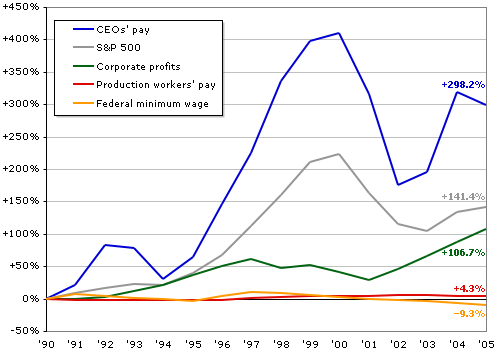
Could there be more profit sharing? Sure. Should there be? Perhaps, but sadly this graph does not show the breakdown of what industries or companies are most profitable, what industries poor people tend to work in and how much profit each poor person generates. It doesn't tell anywhere near the whole story.
Plus a few other things have happened to help the poor-
- child tax credit was introduced in 1998 at $400 ($533 today). Now the child tax credit is $1000 (increased pretty linearly since '98). For someone working full time at minimum wage, that's half their federal tax burden
- SS benefits are for the most part not taxable
- in NY at least, if you make less than $14K (as an individual) you are eligible for food stamps
Plus outright wage growth hasn't been as incredibly disproportionate, as much of executive pay and rich people wealth is tied to returns on investments. Plus for CEOs and most financial employees, FWEIW, pay was almost completely tied to performance, which is NOT the case for most people. What do you think is a fair fee for a team of people who are assigned to manage a billion dollar fund (that may have things like pensions, 401Ks and normal people's mutual funds), and get back a ROI that beats inflation? I think there is value in that... dare I say, more value for a group of 10 people doing that than a group of 10 people running a McDonalds franchise; perhaps significantly more.
So yes in some ways things are skewed. But the solutions for problems causing poverty are not as simple as 'pay CEOs less and double minimum wage'. I still haven't seen anything that says non-CEOs are being paid unfairly for the work they are doing.
-
Of course the solution isn't "pay CEO's less". The federal government should not be able to control the wages of employees in private companies.
But perhaps if there were more thoughtul federal regulations in place, so as to have more appropriate oversight when it comes to hedging, deriviaties, CDO's, etc. (i.e., the more dangerous investment schemes - in general being done with other often unaware investors' money), and more strengthened laws regarding how much an investment bank can invest vs. how much cash it has to keep on hand (i.e., not allowing them to only keep $1 on hand for every $40 they invest), then perhaps those CEO salaries, and, more importantly, bonuses, would not be so stratospheric. Particularly at the expense of their customers.
-
What is a fair wage for managing $1B? Let's consider the following:
* The vast majority of money managers don't beat the market, nor do they achieve required returns given the risk they take (so called alpha is a bs measure. Real portfolio risks are masked).
* $1B is chump change, and to get true economies of scale, you need (a minimum) of 10X that.
* Nonetheless, economies of scale in finance are elusive, at some point the scale of funds becomes unwieldy and so you lose performance. So there is a trade off, low costs from scaling or smaller, higher performing funds.
* Trading costs are falling all the time.
* I can get an ETF and beat inflation for less than 50 bps.
Given all that, I'd say a fund for capital preservation fund (which I assume you mean because we are simply beating inflation) of $1B, I'd be willing to say that they deserve no more than $3M. And that's probably exorbitant. Certainly not the 2 and 20 that the high flyers would have you believe.
-
Plus for CEOs and most financial employees, FWEIW, pay was almost completely tied to performance, which is NOT the case for most people
Is this a joke? By this logic half the financial industry should have been paid $0.00 in 2008 but something tells me the bonuses came anyway, they just weren't as big as usual.
Executive pay has skyrocketed in the past few decades, meanwhile hourly wages have been stagnant or fallen for decades, especially minimum wage.
The distribution of wealth may not be changing dramatically, but who is benefiting from increased production and efficiency sure is a one-way street.
-
Executive pay would be better controlled if public company owners had more control over decision making. And, as ntfool suggests, more transparecy. Right now, exec pay, plus finance pay in general, is largely rigged.
-
BG is certainly right about pay for performance in the finance industry. It's a joke. The vast majority of the time it's not based on the right metrics. Even by their own standards of shoddy metrics, most still fail, but they move the goal posts. This happens far, far too much. If pay for performance were real, I suspect finance pay would fall by perhaps 50% (just a hunch).
-
Boygabriel said:
Plus for CEOs and most financial employees, FWEIW, pay was almost completely tied to performance, which is NOT the case for most people
Is this a joke? By this logic half the financial industry should have been paid $0.00 in 2008 but something tells me the bonuses came anyway, they just weren't as big as usual.
Executive pay has skyrocketed in the past few decades, meanwhile hourly wages have been stagnant or fallen for decades, especially minimum wage.
The distribution of wealth may not be changing dramatically, but who is benefiting from increased production and efficiency sure is a one-way street.
Goldman Sachs alone paid nearly $10 billion (yes, a "b", not an "m") in compensation and bonuses for calendar year 2008. In 2009, it jumped up to $11.4 billion.
But clearly, none of that was from TARP. It was obviously based upon returns generated through solid, legal investments.
-
Relates to Water Ice's posts: http://news.yahoo.com/s/ap/20110127/ap_on_bi_ge/us_financial_crisis_inquiry
-
Goldman Sachs collected nearly $3bn from bailed-out US insurer American International Group as a payout on bets it placed on its own account - with the bulk coming directly from taxpayers after AIG's rescue. The revelation was made in the Financial Crisis Inquiry Commission report into 2008's financial meltdown. losses and collapses" throughout the financial system.
-
Talk about people getting something they don't deserve.
-
As if on cue, yahoo published the following today:
http://news.yahoo.com/s/ap/20110128/ap_on_bi_ge/us_employment_costs -
While low wage pressures mean inflation is subdued, the concern is that unless households start seeing better wage gains, consumer spending will not strengthen enough to give the overall economy a boost.
Funny how that works. Society needs *everyone* to be doing well, not just those CEOs and upper class people who "earn" it.
-
Goldman Sachs collected nearly $3bn from bailed-out US insurer American International Group as a payout on bets it placed on its own account - with the bulk coming directly from taxpayers after AIG's rescue.
GS collected almost $13B from the AIG's U.S. taxpayer bailout. This amount was almost identical to what bonuses were for that year.
-
Yup, $13 billion is correct, not $3 billion.
As an aside (and not to continue piling on Goldman Sachs, but it is easy), an example of our corporate tax laws being utterly usesless - in 2008, the year that Goldman paid approximately $10 billion in compensation & bonsuses to its employees, and as it was receiving the $13 billion payout from AIG - which don't forget was essentially money generated from our taxes, how much did Goldman pay in its own tax filing?
$14 million. Yup, an "m", not a "b".
In fact , a Government Accountabilty Office (non-partisan) report determined that from 1998 - 2005, roughly 2/3 of ALL corporations operating on US soil PAID NO TAXES AT ALL: http://www.gao.gov/new.items/d08957.pdf
Which I guess means we should all thank GS for that $14 million tax bounty.The nation's wealth inequality gap is, at this point, built into the infrastructure of our federal government. Though we can all cite examples of lazy people bilking the welfare system, I do not think the the systematic financial problems we facve have much to do with this or that poor person not earning their keep or making their own way in life.
-
http://www.demos.org/event_list.cfm?currenteventid=BF940062-3FF4-6C82-5CE0DADAEBFFC2D6
"After the 2008 financial crisis and its aftermath a great political divide emerged among many Americans reexamining the direction of our country. One side says that unleashed free-market policies led to the worst downturn since the Great Depression, and calls for effective government to foster more equitable prosperity. The other side says that government has grown too big and too intrusive, and calls for the country to rediscover the virtues of limited government and free-market capitalism."



Howdy, Stranger!
Categories
- 40K All Categories
- 27.1K Neighborhoods
- 5.1K Crown Heights/Prospect Lefferts Gardens
- 7.1K Prospect Heights
- 2.3K Fort Greene, Clinton Hill, Bed-Stuy
- 8K Park Slope
- 549 Williamsburg, Greenpoint, Bushwick
- 442 Flatbush/Midwood/Ditmas Park
- 657 BoCoCa (Boerum Hill, Cobble Hill, Carroll Gardens)
- 151 Red Hook
- 104 Gowanus
- 304 Bay Ridge/Bensonhurst
- 130 Coney Island, Brighton Beach, Sheepshead Bay
- 270 Brooklyn Heights, DUMBO and Downtown
- 598 Windsor Terrace / Kensington
- 673 Greenwood Heights and Sunset Park
- 749 Brooklyn and Beyond
- 6.3K Stuff
- 86 Brooklyn Back When
- 1.2K Brooklyn Pets
- 257 Brooklyn Kids
- 241 Brooklyn Eats
- 51 Brooklyn Booze
- 3.6K The Lounge / Random Stuff
- 611 Brooklyn Politics
- 122 Brooklyn Sports and Fitness
- 111 Brooklyn Photos
- 339 Site Issues
- 8 Frequently Asked Questions (FAQ)
- 6.2K Listings
- 1.1K APARTMENTS and REAL ESTATE
- 1.3K Sales Openings Events
- 2.3K The Classifieds