Time to tax churches and NGOS.
Comments
-
Lottery is most certainly a tax but I've never quite figured out how I feel about it.
It's completely voluntary, yet also nothing but tax, even if people convince themselves otherwise.
-
the lottery is just a stupid tax
 , they could be okay off too and play it lol. i have some friends who have college degrees and play it lol.
 -
please encourage everyone you do not like to play the lottery.
-
doesn't half the lottery money go to education? never bothered to look into whether or not that was bogus.
-
Lottery is bad as casinos etc.. another form of taxing the stupid LOL.
-
they suppose to goto education etc.. LOL but its a fat lie last time i check. very little goes into it.
-
vidro3 said:
doesn't half the lottery money go to education? never bothered to look into whether or not that was bogus.Yes, something like half goes to education.
Hence, I'm all for people playing.
It is (as stated above), a voluntary tax. It also simultaneously a away to give a portion of your earnings to a bodega owner and bureaucrats.
-
More income distribution talk... let's focus here.Boygabriel said:
A joke, as opposed to progressives suggesting we raise taxes on the group already paying the lions' share of taxes
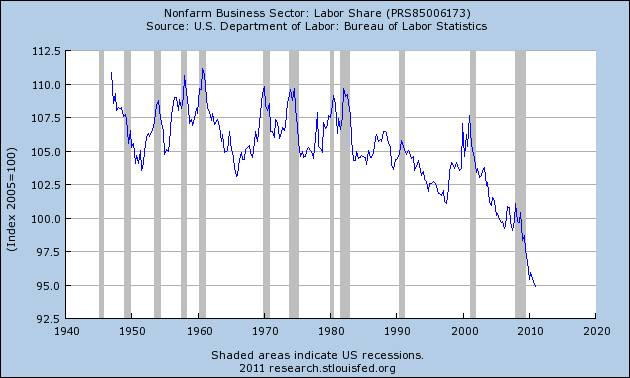
The group who's making the lion's share of the money? Who's income has skyrocketed over the past two decades while everyone's has stayed relatively stagnant? Yeah, that group.
The premise of that graph is highly misleading. In fact the graph raises more questions than answers for me.
It is just not true that public programs are the source of our deficit.Currently single biggest source of our deficit is actually the Bush Tax Cuts, which were enacted in a time of surplus, were intended to expire (now would be a good time, with our debt problems) and never actually brought the trickldown effect that supplysiders all promised, and have been promising since the 80s.

For example, how do they suppose that with SS & MC's growth, their contribution to the debt will shrink over time?
How about the fact that Medicare's outlays have grown on average at about 9% per year? Given the fact that our GDP's growth has been about half that much, and its growth has not curbed at all, how is that not factored in?
We are borrowing 1/2 of what we spend. Social program outlay growth far outpaces GDP & revenue growth. How are social programs not contributing to the debt?
Read more, I implore you:This is a fire sale BG. Everything must get slashed. More taxes are not the answer. The out of control growth of the government is what got us here, not tax cuts. The outpacing of the growth of our outlays vs our revenue/GDP shows this clearly. The only changes that should be made to taxes are the closing of loopholes & behavioral deductions.
No argument here, public debt is a huge problem.
But the idea of tackling it during literally one of the worst economic downturns of the past 100 years, with systematic unemployment or underemployment going up up up, not to mention the very evil return of "speedup" (more productivity, stagnant wages) couldn't be more illogical.
Here's the thing BG.
And I don't want to sound like I am insulting you.
But I really don't think you understand the gravity of the fiscal situation. We are close to borrowing $0.50 for every $1.00 we spend federally. We are 3 weeks away from defaulting on our debt. The gov't has run out of time to deal with its overpromising. Cuts have to be made.
The idea that social programs, which have grown at rates far higher than revenue/GDP, don't have any part in the deficit, is ridiculous. It almost is indicative of a lack of basic understanding of how taxes & gov't spending works. And as awful as you think cuts to gov't programs will be, the day of debt reckoning, when we CAN'T borrow any more money because people decide we cannot pay them back, will be MUCH worse. How you don't understand this, I don't know, but this is what it is BG.
-
CTK, I do not understand why you are so much more focused on the expenditure side of the equation than you are on the income side.
Yes, it is clearly true that the federal government is spending far more than it "earns" in tax revenues. Yet you seem to believe that the solution to the problem is solely to cut expenditures, rather than to do that AND to increase tax revenues.
The Koch brothers, many others like them, and numerous large corporations, have hundreds of millions of dollars to spend on political candidates and lobbyists, in the process warping our electoral and legislative processes.
Surely our democracy, or "republic" if you prefer, would be healthier and far more equitable if some of those thousands of millions of dollars were instead paid as federal income taxes, thereby reducing or eliminating our deficit and possibly repaying some of our federal debt.
Why do you consistently reject that approach?
-
You have me mistaken- I wholly agree that there are a lot of silly and unnecessary deductions that we should ditch in order to generate more revenue. I'm not a goofy libertarian, we are up to our eyeballs here, more revenue should definitely be an option.
But where the revenue should come from is prob where I don't agree w/people here. BG asserts that the tax curve is not progressive enough. I say w/an income tax curve that is progressive to the point that poor people almost pay nothing from the get go, as well as receive deductions for kids AND gov't assistance, that's not the case. Especially considering the 'contribution' curve. People like him on both sides are using this crisis to exact their revenge on the groups they feel are responsible for the problem. The reality is, everyone who has benefitted, rich or poor, is responsible, and everyone, rich or poor, must pay.
I say we get rid of corporate & "rich people" tax deductions along with 'working man' deductions like marriage filing, mortgage interest, kids etc. Everyone has to take a hit. That is the most fair way, and it is the quickest way.
-
even with like minded posters we have a fundamental disagreements. you think those jokers in dc would get this thing done. I highly doubt it. they'll come up with a very short term measures and thats about it.
sadly i invested way too much in this country already, i won't recoup my money decades from now. If i had to do it over again, i probably wouldn't and put my money in something more liquid, also if my family was willing to move again. I ask them this a while back they said too much invested to start over again.
-
ctk wrote: The reality is, everyone who has benefited, rich or poor, is responsible, and everyone, rich or poor, must pay.
I think the argument stems from the fact that some people believe that they have not benefited.
For example, they define "benefited" as meaning "grown wealthier", while others define it as "having received services that were not fully paid for".
Yes, we all have receive some of the largess of our debt.
...but until folks believe that they received it in the same amount they they are about to be hurt, they are going to be opposed.
The wealthy think the poor caused this mess.
The poor think the wealthy caused this mess.Both think the government caused this mess
Its all kinda silly, because we are all in this mess no matter who caused us.
...it sucks, but we are not going to be able to hold any one group accountable.
-
Well therein kind of lies a huge problem w/entitlement programs. Once you pop, it's in nobody's short term interest to stop. And people rationalize the dependency. Things that started out as temporary aids become unalienable rights. And then when the money runs out, everyone grabs a hold of their sacred cow and starts pointing fingers. The whole thing is actually a really ugly reflection of human nature. We are just smart + capable enough to completely screw ourselves over.
The only way out is a painful reset. This economic crisis is here largely in part because of the problems we've been ignoring.
-
Ok everyone, here is your homework for this evening.
http://www.cbo.gov/ftpdocs/120xx/doc12085/03-10-ReducingTheDeficit.pdf
I'll give you a few highlights
Attached files


-
Cool The Kid said:
The premise of that graph is highly misleading. In fact the graph raises more questions than answers for me.For example, how do they suppose that with SS & MC's growth, their contribution to the debt will shrink over time?
How about the fact that Medicare's outlays have grown on average at about 9% per year? Given the fact that our GDP's growth has been about half that much, and its growth has not curbed at all, how is that not factored in?
I never said social programs weren't contributing to the debt. I said they are not the (main) reason we are in debt, which is what you seemed to intimate when you said, "The out of control growth of the government is what got us here, not tax cuts. "
When quite clearly, Bush's tax cuts are perhaps the biggest, or one of the biggest, sources of our debt right now. So I'm not even talking about changing our tax code or rates, but just letting Bush's tax cuts expire, as they were designed to do, as they were instituted in a time of surplus, and as they promised economic growth which never materialized.
But I really don't think you understand the gravity of the fiscal situation. We are close to borrowing $0.50 for every $1.00 we spend federally. We are 3 weeks away from defaulting on our debt. The gov't has run out of time to deal with its overpromising. Cuts have to be made.
I didn't take that the wrong way, and I appreciate your perspective on this topic. However here is the issue I have:
By what reasonable logic is now, in the aftermath (or ongoing in fact) of one of the worst financial crises in 100 years, and some of the worst unemployment we've seen in decades, the time to decide we're going to drastically hack away at our debt?
As most economists argue, and I completely agree, reducing our debt going forward will help long term economic growth.
But the idea of doing this in our current short term environment is completely insane.
We've raised the debt ceiling something like 70 times in 80 years. We did it 11 times under Bush. The idea that THIS is the moment in time to do it, that we can't wait just another 5 years (allowing the govt time to actually get the economy moving again), is criminal insanity.
-
I agree that the Bush tax cuts, along w/various other needless tax breaks/deductions need to go.
But hacking away at debt is not about economic growth. We literally can't afford the debt we have, and you want to add more- not to provide an interim to create a more comprehensive plan or change course- but to delve deeper into the same strategies that have got us to where we are. To me that is insanity.
Not to mention, the creation of all the money we've dumped into the economy has accounted for inflation that hits the people you hold dearest the most. More borrowing would only create more dollars and further that ominous trend. Inflation has been about 35% since the start of the recession... about 9%/year. And that is solely due to the money created to pump into the economy.
This debt crisis is the end result of overpromising. The solution to getting us to where we can be is not more overpromising. If we continue on your path, we will come to an impasse even more difficult than the one we are at now. We might not have the option to borrow more. But if we suck it up now and make cuts, here's what I think will happen:
- inflation will slow tremendously, bringing price growth down to a level that will be palpable by people already suffering.
- investors will be confident in our gov'ts capability to plan & act beyond the next quarterly growth report
- reversal into a surplus will provide reserves that we can lend to banks & institutions at a profit, providing actual cash rather than imaginary money you and I pay for through inflation. Said profitable operations would be a much better source of income for your social programs than tax hikes.
I know this seems like a shitty time, but trust me BG, if we wait we might not get another opportunity to get our heads out of our collective asses for a really long time.
-
Inflation has been about 35% since the start of the recession... about 9%/year. And that is solely due to the money created to pump into the economy.
source please.
even according to shadow stats the cumulative inflation since 2009 is 16%
-

Too lazy to find the point when he says it. Worth the watch anyway.
-
"Ron Paul said it" is not enough to substantiate the claim
-
ron paul seems like the only politician who sticks to his view of points.
-
vidro3 said:
"Ron Paul said it" is not enough to substantiate the claimHe wouldn't say it if it weren't true.
And regardless, there is a direct correlation between debt & inflation.
-
I don't know enough about inflation to comment, but I certainly find your comments interesting.
I do not, however, believe in the "confidence fairy", as Paul Krugman likes to call it.
-
Well, I put it like this then.
The last 3 (edit- 10) years of letting our debt balloon out of control has got us nothing. All the stuff we hoped to get out of it (jobs, growth, low inflation) never materialized. And as far as the confidence goes, I think a lot of it was bullshit too. But right now America's federal debt is its livelihood, and piling on more of it would really bring our ability to get it under control into question- presenting a legitimate question of confidence.
I put it like this- you have a person who's maxed out their CC who has come to a point where they won't be able to pay their bills that month. As the owner of that CC debt, what would you rather them do: figure out how to live within their budget and pay you back, or continue living irresponsibly and take on more debt that they would never pay back? To me, in the long term interest of the country the decision is obvious. I would rather more taxes than more debt. No more imaginary money.
-
I would rather more taxes than more debt. No more imaginary money.
I agree, even if it means that I (rather than just the super-rich) will have to pay more!
-
I would prefer that we accept a "new normal", and stop trying to produce a stimulus by spending more money or cutting taxes.
....government investment is one thing, but under the guise of stimulating recovery (under Bush and Obama) we have implemented tax cuts and huge expenditures. Both have allowed people to continue believing the myth that as Americans we are somehow entitled to unfettered, automatic prosperity, despite the existence of globalization...
That said, this isn't going to be a mess we are able to solve over night. It might take a decade to increase taxes and decrease spending to the degree that it allows us to stop incurring debt.
I see both parties grandstanding and blaming the other.
P.S. I completely understand the grandstanding; no one with a message like mine would be elected or re-elected.
-
booklaw said:
I would rather more taxes than more debt. No more imaginary money.
I agree, even if it means that I (rather than just the super-rich) will have to pay more!
A flat income tax rate all the way down the line (knocking out all the goofy deductions) would generate an additional $130bn/yr just from the bottom 50% alone (at a nominal tax rate of 13%). A 25% flat federal income tax would generate an additional trillion dollars a year in revenue, which would mainly come out of capital gains, while marginally affecting the tax burdens of the avg working American. Combine that w/austerity measures, even w/the shitty economy we could have our debt under control overnight, and paid off within the decade. Even more quickly if we raised the Fed lending rate to anything.
When you look at the gravity of the situation and learn to reconcile the idea of a more logical tax system, things start to look a lot more palpable. To be fair though, short term capital gains are taxed as normal income, and long term capital gains are due for a tax hike in 2013, which should generate a shitload of revenue. Right now they are unrealistically low (long term rates start at 0% till 15% income), and as much as Boehner will fight it they need to go up. I think Obama sees this, but is fighting an uphill battle with the political grandstanding on both sides. To anyone w/a brain the solution is obvious.
-
The trick will be forcing the government to use any such revenue toward reducing the deficit, and not on new spending.
At present, when either political party sees a potential stream of revenue about to come in, they think of programs that it could be spent on and set up obligations that exceed the revenue source's capabilities.
Those who want the debt lowered (or at least to stop its growth) have had no voice in government, we have only had politicians who wanted to show how the government under their leadership could make the lives of their constituents better in the short term.
It think the last politician to get the country to focus on the issue was Ross Perot. Although he was a fool, this isn't a foolish issue.
-
what i'm afraid of is if they do add new taxes, they'll try to shift it around to fund their pet projects so they can be reelected again and again.
we should have a pool to see if they are actually going to cut spending and do something useful with any new money coming in.
-
Cool The Kid said:
Well, I put it like this then....
I put it like this- you have a person who's maxed out their CC who has come to a point where they won't be able to pay their bills that month. As the owner of that CC debt, what would you rather them do: figure out how to live within their budget and pay you back, or continue living irresponsibly and take on more debt that they would never pay back? To me, in the long term interest of the country the decision is obvious. I would rather more taxes than more debt. No more imaginary money.
Right but in your CC metaphor, I am arguing that if the individual chooses to try to recalibrate their finances right now today, it will put them out of work, and/or dramatically reduce social programs for the less privileged, or make their financial situation infinitely more of a mess, which makes long term prospects for paying off debt even worse, IMO.
On your later post:
You support a flat tax? Am I reading that right?





Howdy, Stranger!
Categories
- 40K All Categories
- 27.1K Neighborhoods
- 5.1K Crown Heights/Prospect Lefferts Gardens
- 7.1K Prospect Heights
- 2.3K Fort Greene, Clinton Hill, Bed-Stuy
- 8K Park Slope
- 549 Williamsburg, Greenpoint, Bushwick
- 442 Flatbush/Midwood/Ditmas Park
- 657 BoCoCa (Boerum Hill, Cobble Hill, Carroll Gardens)
- 151 Red Hook
- 104 Gowanus
- 304 Bay Ridge/Bensonhurst
- 130 Coney Island, Brighton Beach, Sheepshead Bay
- 270 Brooklyn Heights, DUMBO and Downtown
- 598 Windsor Terrace / Kensington
- 673 Greenwood Heights and Sunset Park
- 749 Brooklyn and Beyond
- 6.3K Stuff
- 86 Brooklyn Back When
- 1.2K Brooklyn Pets
- 257 Brooklyn Kids
- 241 Brooklyn Eats
- 51 Brooklyn Booze
- 3.6K The Lounge / Random Stuff
- 611 Brooklyn Politics
- 122 Brooklyn Sports and Fitness
- 111 Brooklyn Photos
- 339 Site Issues
- 8 Frequently Asked Questions (FAQ)
- 6.2K Listings
- 1.1K APARTMENTS and REAL ESTATE
- 1.3K Sales Openings Events
- 2.3K The Classifieds