charter school co-locations in crown heights/prospect heights??
Comments
-
I fear that existing public schools believe that they are "entitled" to any growth in student population that is expected in their zone.
In reality, no entity owns those future students. Those students and families are going to get to choose where they attend.
When one designates funding (or classrooms) in advance of their choice, their ability to actually choose becomes less real.
-
The UFT is going to be in a fight for its life.
http://gothamschools.org/2013/08/29/charter-school-advocates-look-for-an-opening-on-city-council/
-
Everyone loves to accuse the charter schools of being exclusive, and selective. The charter schools seem to be taking it in stride.
Sponsored by KIPP:
You're invited to KIPP NYC's Diversity Speaker Series featuring
Lisette Nieves
Wednesday, September 25th
5:30 PM - 8:30 PM
1224 Park Place, Brooklyn, NY [Directions]SIGN UP NOW as space is limited:
http://lnk.kippnyc.org/divspk13We all know that college completion rates for students of color and students from low-income communities in the U.S. are roughly half that of their more privileged counterparts. But why? And what can be done to eradicate this gap?
http://us2.campaign-archive1.com/?u=5e3f2b5235584d5ae12cb8667&id=cd1cacb58c&e=d657f23ad1
-
Part of the strategy of Charter Schools is to hire young teachers.
They believe what they lack in experience, is outweighed by the energy and optimism they bring.
...they also are a lot cheaper.
http://nypost.com/2013/10/03/study-charter-schools-actually-cheaper-than-public-schools/
-
Faced with a policy that would cause them to have to pay NYC rent, the charter schools show their might:
http://nypost.com/2013/10/09/thousands-rally-against-charter-school-rent-plan/
DeBlasio, are you ready?
-
The entire co-location issue is a structural one resulting from the state charter law and not a issue of "Wealthy" charters vs. "poor" public schools.
The state calculates a per-pupil cost for each student, however, that cost does not take into account facilities costs which are accounted elsewhere in the education budget. Charter schools receive this per pupil fee (the same amount which funds each regular public school student instruction)from the state, but are expected to fund BOTH instruction and facilities our of these funds. Rather than try to change the law, Bloomberg's answer was to get rid of this disparity by giving charters in NYC access to the same facilities - thereby erasing this disparity. This is an inelegant solution, but it has proven to be effective from a budgetary perspective.
There are places that have figured out how to do facilities funding properly. In Washington, DC the law provides for two payments - per pupil dollars and a separate amount for facilities. Those two payments follow each child whether they attend a regular public or a public charter school. Regular public schools still have a better deal as their facilities benefit from the economies of scale of a system (lower custodial, maintenance, and utilities costs), but they have no co-location fights as schools have revenue stream they can use to finance leasing or acquisition.
So many people seem to approach the charter discussion from their opposition to Eva Moskowitz. But for every Success Academy, there is an independent charter operator like Brooklyn Prospect or Citizens of the World. Bloomberg has always pushed those groups that were doing well to replicate in the city which is why you are starting to see networks such as KIPP, Achievement First, Excellence etc. but the charter movement is also a lot of small schools that aren't backed by huge corporate dollars. Those schools deserve a chance to start and grow as well.
-
In other cities, charter schools are maligned as being "white". I think that tactic is not used by opponents in NYC because it doesn't fly.
Attempting to paint them as being wealthy, and thus not needing public money, is really the only card they have.
It has become clear to me that the opponents of charters genuinely fear that they will be left with the worst of the students, and teachers. However, the public school advocates (charter school opponents) are smart enough to know that if they were to campaign on these genuine fears, very few would listen.
-
NYT writes a piece that is pretty bland:
-
In other cities, charter schools are maligned as being "white"
My experience in large urban school systems has been that the vast majority of charter schools serve overwhelmingly minority populations (LA, NYC, DC, New Orleans). One of the big complaints is that when parents are given "choice" they often choose schools that have homogeneous populations. I think this plays out in the selection of public schools as well, its just a lot easier to make the argument that the reason for this choice is everything but race.
This article describes some of the issues of charter segregation in the Twin Cities. Important takeaways:
Moreover, for a variety of reasons, white, middle-class parents often gravitate to schools populated by those who look like them, Perry says.
“Middle- and upper-middle-class families have always tended to—in my opinion mistakenly—connect quality with sameness,” he said. “It could be an explicit effort to segregate, but it’s more likely a result of this notion that diversity is a sign of poor quality.”
It isn’t just white families that self-segregate. Black families are still more likely to enroll in racially isolated charter schools than white families, Miron said.
Frankly, I think those successful charters in NYC are doing a much better job bringing together communities that mirror the neighborhoods that they are based in. However, I know that there are plenty of people moving into this neighborhood that would never consider enrolling their child in a charter school. So once again, fights over things like co-location are really just a smokescreen for issues we don't want to discuss.
But educators and policy makers are divided over the significance of the trend: Charter critics say the movement has fostered a rise in the number of racially isolated schools while others maintain that schools like Seven Hills are symptomatic of enduring self-segregation throughout America’s education system now manifesting itself through parental choice.
“We have a long history of families and communities segregating themselves,” said Andre Perry, the associate director for educational initiatives at Loyola University’s Institute for Quality and Equity in Education in New Orleans. “It’s somewhat wrongheaded to say that charter schools are an impetus for segregation. The people are the impetus for segregation.”
-
I think those successful charters in NYC are doing a much better job bringing together communities that mirror the neighborhoods that they are based in. However, I know that there are plenty of people moving into this neighborhood that would never consider enrolling their child in a charter school. So once again, fights over things like co-location are really just a smokescreen for issues we don't want to discuss.
Yup.
For the parents, this isn't about co-location or any sympathy with UFT goals.
This is about wanting what they believe is best for their child, and that is about having the power to send your kid to a school with the ability to exclude.
Let's be honest: No parent wants "inclusion" when their kid is not the one who will benefit.
-
actually, in NYC, most charters are not serving populations similar to the districts where they're located. and it's not only the choice mechanism - it's the fact that charters don't have to accept kids to fill vacant spots like a district school does. as a result, NYC charters typically serve kids with a more advantaged population than their district counterparts: more affluent, fewer English language learners, and fewer special education students. this is true regardless of the type of charter: no-excuses, traditional, progressive. Take a look at Community Roots demographics compared to District 13 for an extreme example. Even the NYC Charter School Center accepts that this is fact.
In my experience, when families who've never stepped a foot into their zoned school reject it outright (as many do), they do so for two reasons: 1) the data tells them that the school is low-income and therefore "bad;" and 2) this is confirmed for them when they see a lot of minority children at the school. conversely, if they understand a school to be affluent and therefore "good," the presence of minorities doesn't dissuade them.
i don't think anyone would suggest that charters are creating something new with respect to segregation. the issue is that the charters were sold as a "solution" to the problems of urban education and now, instead of solving problems, they are making them worse. you're right that people are concerned that this is really just another sorting mechanism that will result in extreme concentration of poverty and dysfunction. but if you followed education activism you'd know that most people aren't afraid - at all - to address this head on.
whynot, i think you underestimate the benefits of inclusion. it's not a zero sum game, where one kid gains and all the others must therefore lose. and, more generally, i know many MANY parents who don't think the "power to exclude" is what's best for their kids.
I am not sure that anyone who really understands what's going on with charters (and isn't running for mayor) draws the kind of bright line between success academies and "everyone else." For example, Citizens of the World is also a charter chain, and it was recruited to come to Brooklyn by Eva Moskowitz's husband, against the wishes of the D14 community. And now, despite openly marketing itself primarily to rich, white families, it filled fewer than half of its seats and is in jeopardy of being closed.
Brooklyn Prospect doesn't co-locate, so there's that, but otherwise it doesn't seem much better. (affluent but poorly performing school, poor tests, fake diversity, etc.)
-
I know many MANY parents who don't think the "power to exclude" is what's best for their kids.
I don't know one.
Every parent I know wants their school to be able to exclude kids/families whom they deem as violent, disruptive, or disabled in a way that slows their kid's learning.
To the extent possible, every parent I know looks for built in screens to ensure that their kid's learning environments are not affected by "those kids".
When implicit things like property values aren't effective enough, charter schools are seen as an option.
-
actually, in NYC, most charters are not serving populations similar to the districts where they're located. and it's not only the choice mechanism - it's the fact that charters don't have to accept kids to fill vacant spots like a district school does.
I'm not sure I understand what you're saying here. Is it that charters are choosing not to fill a vacant seat rather than fill it with someone who they don't want? Or are you saying that charters don't have to take every student that applies? My experience has been that charters either have not enough students to fill seats or are oversubscribed and use their lottery and waiting lists accordingly.
-
whynot - you said
This is about wanting what they believe is best for their child, and that is about having the power to send your kid to a school with the ability to exclude.
Let's be honest: No parent wants "inclusion" when their kid is not the one who will benefit.
that implied something VERY different, and far more alarming, than excluding violent kids from the classroom, as your clarification suggests you meant. but even your clarification has a lot of assumptions embedded in it. I will just put it this way: there are plenty of parents out there that might harbor a secret fantasy of ruling the world, but we don't lobby for despotism because what happens if my kid is the one "deemed" disruptive by some precious mom who wants the class to learn to knit instead of do math? what happens to all of the other kids who are pushed out and squished together so that some favored charter can have a chess room? the answer is: they show up on the street corner, have babies at 14, make your life and your kids lives unpleasant, cost society tons of money in lost human capital and prison costs, etc.
-
homeowner: charters are not required to backfill, that is, not required to fill seats that might open up when a student leaves. so let's say Explore Exceed finds 2 kids to be "disruptive" and having difficulty complying with the charter's rules and tells them that they will have to repeat 2nd grade if they stay at the school. Parents don't want that, so parents pull kids out. Kids are zoned for PS 705, so PS 705 must take them. Explore Exceed is not required to fill those 2 vacant seats regardless of the so-called waiting list, and most of the "no excuses" charter schools do not. That is why, for example, you can see charter middle school 5th grade classes start with 80 kids and have only 54 by the time that class is in 7th grade...and those 54 are the ones who have "made it" in the charter's strictures.
I have not read any stories that suggest that charters that do backfill do it selectively; rather, it's that most of the no-excuses schools don't do it at all - some will do it in kindergarten and 1st grade, but not beyond that.
For the "progressive" charters that do backfill and which I understand to truly be oversubscribed, while I've heard rumors that they cherry-pick from wait lists, I know for a fact that district schools cherry-pick from their own wait lists (which is also unfair and also certainly motivated by the desire to have a community of families that "really want to be there" and "contribute positively to the school" etc.).
-
As a final side-note, I think we need to be skeptical about the veracity of the so-called "charter school waiting list" that the new York post loves to throw around as a way of showing the alleged demand for charter schools. It's a fun number but the charter school folks have steadfastly refused to say how they're coming up with it, and it almost certainly includes a lot of double counting.
That said, I think we should have a way of assessing what kind of demand there is for what kinds of schools. It would be an important public policy and city planning tool. The charter school authorizers and the DOE have made clear that the current process is essentially a sham.
Here also is an instructive story about the sometimes illusory "charter school demand": http://gothamschools.org/2013/10/07/under-pressure-charters-nix-cash-for-applicant-tactic/
-
Not having to backfill is one of the main ways in which charters are able to exclude.
It eliminates the kids who have such unstable homes that they have to change schools due to eviction, and being bounced from one foster home to the next.
Parents know this, and it is part of why they perceive charter schools as more attractive.
Even when charters are lousy at implementing their ability to exclude, the parents are unaware. Hence the charters tend to attract parents that want (and actively pursue) what they believe is best for their kids. This makes them different from some public school parents.
In general, parents are much less likely to pursue larger social goals at the perceived expense of their own children, then school employees are with other people's children.
-
some good reading in the NYT yesterday:
http://www.nytimes.com/2013/11/06/business/a-rich-childs-edge-in-public-education.html?_r=0
-
I'm surprised you didn't include this one from the Times as well:
Why Don't We Have Any White Kids?
He has spoken to white parents trying to comprehend why the local schools aren’t more integrated, even as white people move in. “They say things like they don’t want to be guinea pigs,” he said. “The other day, one said, ‘I don’t want to be the only drop of cream in the coffee.’ ”
-
It wasn't published this week. But, yes, that is certainly a big part of the equation.
In the public discourse, we don't like to discuss that there are not "four" types of schools: Public, public charter, private and religious.
The types are endless. The varieties are created not only by the students, parents and teachers ....but also our perceptions of these groups and individuals.
-
Homeowner-
I have a little time on my hands tonight, and will use it to give some more attention to the issues you are raising.Yes, white parents are very hesitant to send their kids to a predominantly black school. In most cases this is because such schools are rated poorly, and they do not believe their child will be well received by the other students. As a result, public schools tend not to be racially or economically integrated.
There are, however, exceptions:
Sometimes (especially in neighborhoods undergoing radical racial and/or economic change), you find public schools that appear integrated at first glance, but when you look closer, you find "special places" are created for those who are "different".
For example, in my high school, an AP program was created so the children of college educated parents would also be likely to go to college. These classes were for the kids who were "different", which in my school meant they were almost exclusively white or asian, and had a household which consisted of two, salaried parents.
The AP program helped the area maintain families that were wealthy enough to own their homes, yet not wealthy enough to afford private schools. It gave these parents the "power to exclude" that I discuss above.
When a neighborhood becomes predominantly such families, you tend to see a different phenomena. In this situation, the majority places the "different" students in Special Education. In most districts in the US, these kids tend to be from lower income families, whom have only one parent, and are black or hispanic.
Needless to say, none of this is "news".
NYC Charter Schools, however, put an interesting twist on all of this. They have arisen, in part, because the families who select them feel they provide "them" with a chance to escape students and families whom they feel will impede their child's learning. Like the schools I attended, this subset of parents perceives themselves as a minority in the school district and wants a place to be "different".
A racial analysis is insufficent, and until we get to a point where it doesn't confuse the average taxpayer that they are "all black, yet don't see themselves as the same", we will continue to debate charter schools.
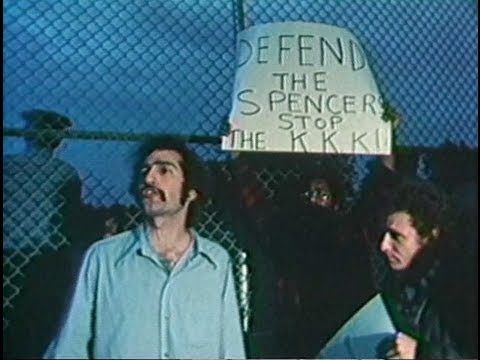
All of which brings me to film below. Until we get to the point where we can commiserate (yet not agree) with both sides depicted in it, we will be in this boat.
The film takes a full hour to watch, and is for adults. Although filmed in 1976, in my view, it speaks exactly to the issue we are discussing, yet (in this case) the motivations play out racially.
It is thought provoking to the degree that it is likely WAY BEYOND the level it can adequately be discussed here. I'll get together with anyone who wants to discuss it in person.
Sadly, we rarely get such well made films in 2013.
-
There are quite a few integrated schools. I attended Brooklyn Tech back in the late 60s, early 70s and there was no majority that I could see. There was probably a pretty even split between white, black and Asian. I think to solve the problems of integration or lack thereof is not a racial thing. It's a motivational thing. Parents need to be sure their children are doing the best they can in school and help them when necessary. When all the students are trying to receive the best education they can and put forth the effort to do that race becomes much less of a factor.
-
While there are many racially integrated schools in NYC, the charters are thriving in areas in which the schools/neighborhoods are not racially integrated.
As discussed above, the charters are thriving on the perception that some students are not present, and/or will be eliminated and not replaced.
In my view, the drive to get the best for your child is merely a fact. It is neither good or bad.
-
This study compares the attrition rate of NYC Charters to nearby traditional public schools.You may find the results surprising.http://links.govdelivery.com/track?type=click&enid=ZWFzPTEmbWFpbGluZ2lkPTIwMTQwMTA5LjI3Mjg4MjgxJm1lc3NhZ2VpZD1NREItUFJELUJVTC0yMDE0MDEwOS4yNzI4ODI4MSZkYXRhYmFzZWlkPTEwMDEmc2VyaWFsPTE3OTI3MjQ4JmVtYWlsaWQ9d2h5bm90XzMxQHlhaG9vLmNvbSZ1c2VyaWQ9d2h5bm90XzMxQHlhaG9vLmNvbSZmbD0mZXh0cmE9TXVsdGl2YXJpYXRlSWQ9JiYm&&&100&&&http://bit.ly/1bUVp4A
-
Not at all surprising, whynot31.Well, not to me, at least.
-
Although he doesn't like charters, DeBlasio may have to utilize them in order to implement his much touted pre-k plan.http://mobile.nytimes.com/2014/01/17/nyregion/de-blasio-a-critic-of-charter-schools-may-need-them-for-his-pre-k-agenda.html?referrer=Reality Bites?
-
and, although it was a good campaign strategy, his plan to charge charter schools rent isn't assured:
http://www.nytimes.com/2014/03/10/nyregion/in-rent-plan-for-charters-mayor-faces-a-hard-road.html?ref=nyregion&_r=0 -
DeBlasio's butt kicked:
"Tentative Deal Struck To Protect Charters In State Budget
Gov. Andrew Cuomo and state legislative leaders struck a tentative deal on charter schools during budget negotiations yesterday that would increase per-charter pupil spending statewide and force the City to provide rent assistance to charters. Per pupil funding would rise $1,100 over three years, starting with $250 the initial year, then $350 the next, and $500 the third. The boost would amount to an increase of about 3.4 percent. Also, the city would be forced to look for space for charters in public schools, or provide rent money for them to use in private spaces, which could cost up to $40 million a year. According to the deal, a third-party arbitrator would make a final ruling if the City and a charter school disagree over a co-location plan and the City would be barred from charging rent for space in public school buildings. The deal would also force the City to find space for the three Success Academy schools run by Eva Moskowitz whose co-locations were rolled back last month. The plan does not, however, offer building aid for charters to replace the $210 million in capital funding that Mayor Bill de Blasio recently diverted away from charters."
Quoted from Gotham Gazette. -
Success Academy, a charter with swagger:
-
Is it all about money?
Public Schools for Sale? from BillMoyers.com on Vimeo.
Do motivations even matter?



Howdy, Stranger!
Categories
- 40K All Categories
- 27.1K Neighborhoods
- 5.1K Crown Heights/Prospect Lefferts Gardens
- 7.1K Prospect Heights
- 2.3K Fort Greene, Clinton Hill, Bed-Stuy
- 8K Park Slope
- 549 Williamsburg, Greenpoint, Bushwick
- 442 Flatbush/Midwood/Ditmas Park
- 657 BoCoCa (Boerum Hill, Cobble Hill, Carroll Gardens)
- 151 Red Hook
- 104 Gowanus
- 304 Bay Ridge/Bensonhurst
- 130 Coney Island, Brighton Beach, Sheepshead Bay
- 270 Brooklyn Heights, DUMBO and Downtown
- 598 Windsor Terrace / Kensington
- 673 Greenwood Heights and Sunset Park
- 749 Brooklyn and Beyond
- 6.3K Stuff
- 86 Brooklyn Back When
- 1.2K Brooklyn Pets
- 257 Brooklyn Kids
- 241 Brooklyn Eats
- 51 Brooklyn Booze
- 3.6K The Lounge / Random Stuff
- 611 Brooklyn Politics
- 122 Brooklyn Sports and Fitness
- 111 Brooklyn Photos
- 339 Site Issues
- 8 Frequently Asked Questions (FAQ)
- 6.2K Listings
- 1.1K APARTMENTS and REAL ESTATE
- 1.3K Sales Openings Events
- 2.3K The Classifieds