Select Bus Service and other changes on Nostrand Jan 2013+
Comments
-
Maybe they should have finished that work before they decided to muck about with that SBS line. And there's absolutely no reason to bump out sidewalks on an already fairly narrow Nostrand Ave. I hope Polly T. does not continue the previous DOT-nazi's penchant for painting all the streets of NYC. In any case, making Nostrand hard to navigate by car and even harder to park must be doing wonders for all the businesses along the avenue. (also along Rogers) Mostly, probably just shifts traffic to other north/south streets.
-
morralkan,Expect it to continue. From what I can tell, there's an ongoing culture shift with the younger generations having more student loan debt and as a result, lower car ownership rates. They also like to live in cities, and apparently they really love Brooklyn. This is a generalization, of course, so take it with a grain of salt, but it's also statistically accurate.Also, from what I can tell, the whole bike lanes and bus lanes thing is also happening in numerous cities across the U.S., across the political spectrum as well.As to Rogers, there have been many vacant storefronts even before the bus lane went in, so in my opinion, bringing more foot traffic to Rogers (the people going to and from the new B44 bus stops) will be good for business.
-
Still no reason to bump out those sidewalks. They have SBS along 34th St in Manhattan, along with those street side ticketing machines, and absolutely not one single bump-out. With much greater bus usage on 34th St, why are these bump-outs needed in Brooklyn? Polly should pay attention to the condition of the roads, something in which Sadik-Khan had very little interest. That has contributed to the current horrible condition of our streets. Incidentally, decent streets are very useful even for bikers. Painted bike lanes are less important than cleaning up all the potholes and other impediments.By the way, virtually no other city in the US has the population density of NYC. Cleveland, for example, has many wide streets and a much lower population, so it makes more sense for bike lanes to exist there. They're little-used by the way.
-
In terms of density issues, you may need to look overseas at areas with high densities.
Many of the first world countries are giving preference to public transportation over other forms, and using sidewalk bump outs to slow traffic.
Sometimes it is an unspoken strategy is to first get control of the street for buses and trollies, then repair them.
Having roads in disrepair, filling them with buses and traffic cops, and making them a general pain via traffic calming methods (ie bump outs) helps with the ultimate goal: Cause people to get rid of their cars, use them less, and/or get lots of revenue from them. -
If you want to give control of streets to public transportation, then supply more of it.It appears that you (and many others) want to demonize cars for a variety of reasons. Even if all cars ran on non-polluting forms of energy, (the general) you would still object to them. If you think those first world countries are so wonderful, then (the general) you, and Sadik-Khan, should move to Amsterdam or whatever city you think is so great. This is New York, not Podunk.As I said earlier, even bicycle riding is far more pleasant on well-paved streets.And that bumped-out street corner, along with inattention by a pedestrian,could well have been the cause of the said pedestrian's death by garbage truck along Kingston Avenue a few months ago.
-
Helping pedestrians and bikers is a secondary goal. The primary goal is making it very painful to drive a privately owned car in NYC.The advocates are achieving their goal.
-
Helping pedestrians and bikers is a secondary goal. The primary goal is making it very painful to drive a privately owned car in NYC.
They still have a long way to go though unfortunately. As with guns, progress has been made, but both are still being used to violently kill and cripple scores of New Yorkers every year. (Guns at least don't cause anywhere close to the same amount of environmental and property damage to this city.)The advocates are achieving their goal.
-
Sympathy for people who are killed and crippled is what motivates some advocates, but my sense is that this is really a reconfiguring of fiscal policies.Those who wish to subsidize privately owned vehicles (POVs) are losing out to those who wish to subsidize:1. Nothing.2. Or, public transportationhttp://nation.foxnews.com/2014/04/29/white-house-lift-ban-interstate-tolling-fund-87b-fixesDon't worry, POVs won't go away. They will merely become more expensive to operate.
-
It seems to me that there is really no strong desire to subsidize public transportation either. Given the cost of building new subway lines, which are really essential to moving large numbers of people around quickly, it's unlikely that we will see any new such line begun during my lifetime (and well after also). All those who want to tame traffic and narrow the streets fail to realize that bottlenecks result and that even the buses have to slow down as a result. On East 34th Street, where there is an SBS line and a dedicated bus lane, that lane is still used to drop people off at hotels and at off-site hospital facilities, to pick up garbage, for moving vans, for vehicles needing to make right turns, and a variety of other purposes. When there is light traffic in general, those lanes are great. Then again, traffic in the other lanes also moves rather speedily. At the height of rush hour, one can still walk just about as quickly as the bus moves.
-
Money for new subways is far more elusive than money to paint a lane.
-
All mass transit in this city is subsidized. The amount of the subsidy differs from mode to mode, but there is not ONE mode of public transportation where the user pays 100% of the cost of their usage.
The bikers have done a good job of pointing this out with respect to personal vehicles, but have failed to address the question as to what happens when enough drivers are dis-incentivized that roads no longer have an adequate revenue stream to pay for operations and maintenance. They have also been surprisingly quiet about how
Subsidies (% of operating expense subsidized):
MTA: 44.5% (subway and bus)
Metro North: 63.8%
LIRR: 73.4%
PATH: 59%
NJ Transit: 44% (rail and bus)
Access-A-Ride: 96%
Bikes: Its unclear what the subsidy is on Citibike on a per bike basis, but its not making money, which means its "farebox" (fare collections) aren't covering its operating expenses even when you account for the roughly $50 million in subidy it gets in the form of advertising fees.
Bottom line is that if everyone were to pay actual cost for transportation, all transportation expenses would increase to the point of being unaffordable. -
This is all complicated by the fact that the various subsidies arguably are not paid for by anyone, because governments operate at a deficit.
...or (similarly), we create quasi public authorities which issue perpetual debt.
So, yes, this is all a matter of which group gets a greater portion of the borrowing.
It is a complicated matter of who has power.
So far, only the group served by Access A Ride has been able to successfully win the "right to transportation".... -
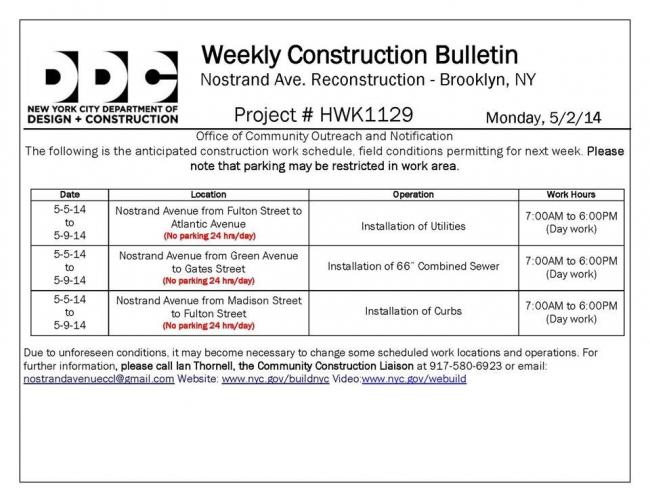
This afternoon, I rode from Home Depot (Nostrand/DeKalb) down to Nostrand/Atlantic. In addition to the sewer project, which seems nowhere near completion since there are numerous big, concrete conduits sitting on the streets, many if not most of the blocks were partially dug up and there was no evidence of any roadbed work having been completed, much less started, anywhere along that route. If the SBS is running quickly north of Atlantic Avenue, it must be sometime during the middle of the night on Sunday.
-
This guy says SBS is not running well south of here, in Sheepshead Bay:
-
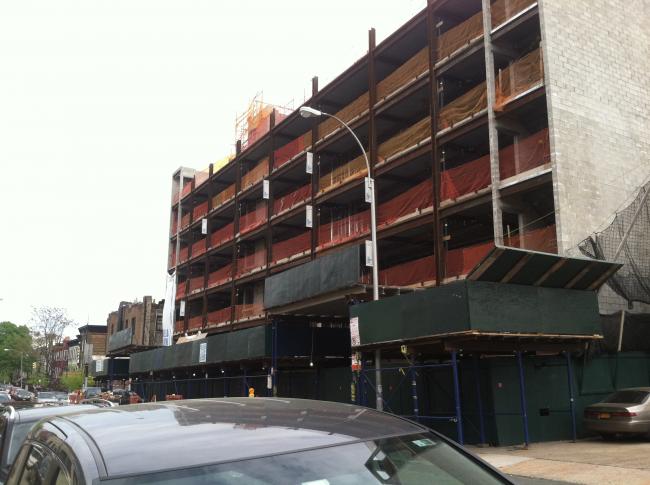
Progress is not really visible in these photos, but it is being made.The Hello Living building on Sterling near Nostrand looks like it is now about 4 months from getting windows.
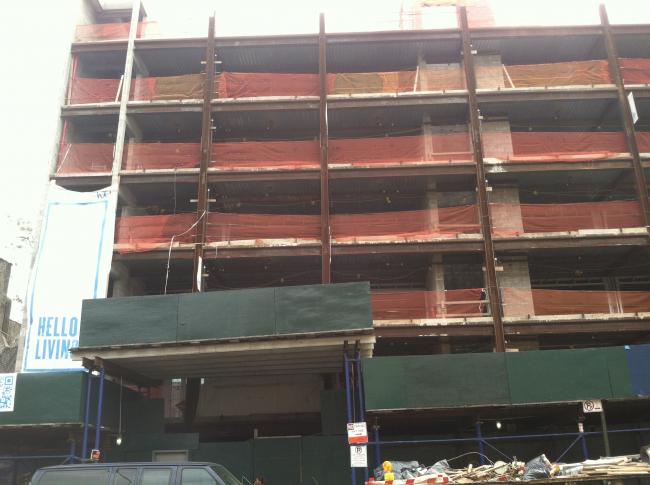
-
All mass transit in this city is subsidized. The amount of the subsidy differs from mode to mode, but there is not ONE mode of public transportation where the user pays 100% of the cost of their usage.
The bikers have done a good job of pointing this out with respect to personal vehicles, but have failed to address the question as to what happens when enough drivers are dis-incentivized that roads no longer have an adequate revenue stream to pay for operations and maintenance. They have also been surprisingly quiet about how
Subsidies (% of operating expense subsidized):
MTA: 44.5% (subway and bus)
Metro North: 63.8%
LIRR: 73.4%
PATH: 59%
NJ Transit: 44% (rail and bus)
Access-A-Ride: 96%
Bikes: Its unclear what the subsidy is on Citibike on a per bike basis, but its not making money, which means its "farebox" (fare collections) aren't covering its operating expenses even when you account for the roughly $50 million in subidy it gets in the form of advertising fees.
Bottom line is that if everyone were to pay actual cost for transportation, all transportation expenses would increase to the point of being unaffordable.
Citibike receives ZERO subsidy. That was a well publicized fact when it opened. It is privately owned (with required payments to the city) and was privately funded. It is the only mode on your list that actually contributes to the cities coffers, not drains. -
This afternoon, I rode from Home Depot (Nostrand/DeKalb) down to Nostrand/Atlantic. In addition to the sewer project, which seems nowhere near completion since there are numerous big, concrete conduits sitting on the streets, many if not most of the blocks were partially dug up and there was no evidence of any roadbed work having been completed, much less started, anywhere along that route. If the SBS is running quickly north of Atlantic Avenue, it must be sometime during the middle of the night on Sunday.
Yeah it is a complete mess around there. Yesterday it took me only 20 minutes to get from Rogers/St. Johns to Williamsburg Plaza, and at least 35 to go the same distance back through all that messy construction.I guess though it has to get done sometime... -
This is false. Citibike receives zero public subsidy. But the Citibank advertising deal subsidizes the overall operations of the program. If that deal were not in place it would be impossible for the service to operate. And if you look at what has happened with that program, the minute the announcement came out that Citibike was in fact, not as profitable as expected, the first response was discussions of ways in which the governement could step in and keep it affordable and afloat.
Citibike receives ZERO subsidy. That was a well publicized fact when it opened. It is privately owned (with required payments to the city) and was privately funded. It is the only mode on your list that actually contributes to the cities coffers, not drains.
It's deeply subsidized by private dollars, but because that money comes above the line in a private company, its impossible to compare to other public transit options. What we can glean from this however, is that it is not the self-supporting operation that its PR staff would like you to believe, nor does it necessarily stack up favorably to other forms of publicly used transportation from a balance sheet perspective. -
DOT recently published this snazzy video about its work maintaining the streets.
This thread seems the right place for it:
https://m.facebook.com/story.php?story_fbid=10152140794327887&id=166279802886 -
DOT has been busy on the stretch of Nostrand in Bed Stuy:
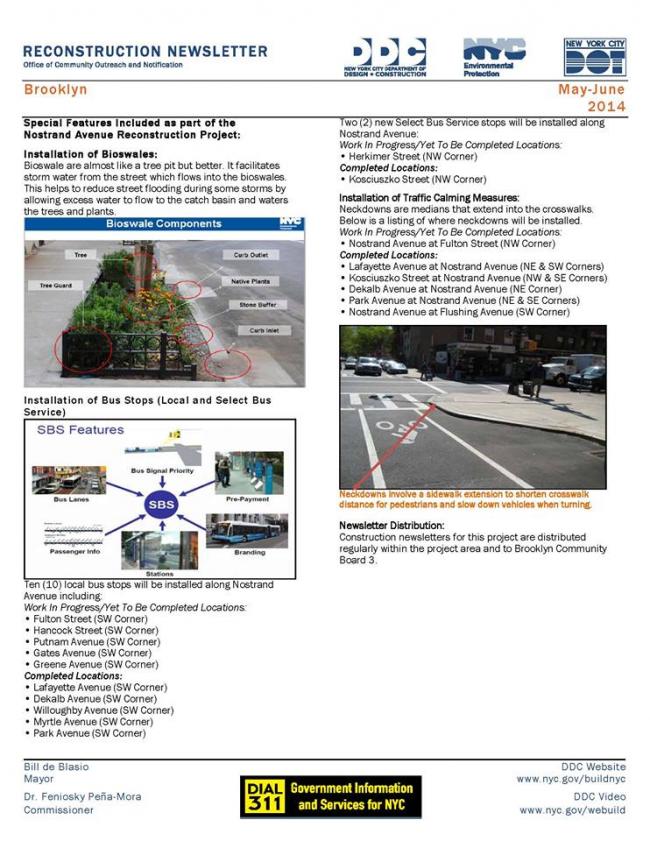
-
The building on Sterling near Nostrand is going to have big balconies, like the other Hello Living buildings.
I understand they are a "bonus area" that doesn't count toward the building's FAR, but I don't like how they look.
http://www.helloliving.com/development/hello-sterling/
I liked the rendering below more than what is actually being build.whynot_31 said:
The Hello Living building is now as tall as it is going to go, and they will soon close the envelope:
Construction seems to be well under way at Hello Living’s tenth development, 834 Sterling Place, between Nostrand and Rogers in Crown Heights. Developer Eli Karp started building the six-story, 46-unit development at the end of last year, and now all six stories are up. New building permits from the DOB say the building will have 40,585 square feet of residential space, 23 parking spaces behind the building, and 29 bike racks inside.
http://www.brownstoner.com/blog/2013/09/checking-in-at-hellolivings-834-sterling-place/#commentsToday, I found a rendering of what it is supposed to look like when complete:

834 Sterling Place
A new ground-up construction of a 5 story Steel & Concrete on Metal Deck building with 46 luxury unit Condominiums with parking lot located at Crown Heights, Brooklyn.
Location: 834 Sterling Place. Brooklyn, NY
Total SQ. FT. 60,305
Structure: Steel & Concrete on metal deck
Year of Completion: 2014
Project Summary: 6-stories 60,000 sq. ft 43 units Condo Building
Company name/Owner: HelloHousinghttp://www.nebglassmetal.com/sub/usneb/project25.htm
Note, the design may have changed since this rendering was created.
-
Long time reader, first time poster. I walked past Hello Sterling yesterday and it appears work has stopped for some time. Does anyone have an update on the progress? I would have thought they would have had the envelope sealed by now and been far along with the interior finishes.-Adam Dahill
-
Welcome Adam.
I have this week off, and was able to able see workers in there today.
I also saw new trees at the SBS stop in front of Lula bagel: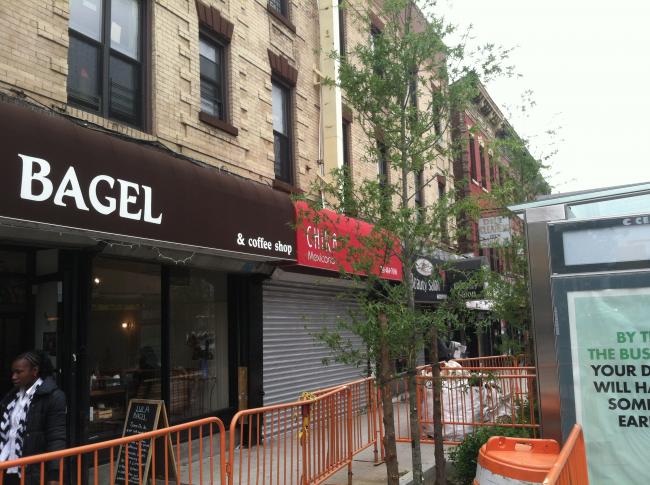
-
Yes, lots of new trees were planted in the area. Saw a great deal on Brooklyn Ave and they look great on Nostrand. Anything we can do to clean up the curb appeal on Nostrand is appreciated. If only we can do something about the litter which is everywhere.
-
My hope is that as the storefronts become filled again, their occupants will sweep in front of their stores.
Tickets from the city sometimes encourage such good behavior. -
This is false. Citibike receives zero public subsidy. But the Citibank advertising deal subsidizes the overall operations of the program. If that deal were not in place it would be impossible for the service to operate. And if you look at what has happened with that program, the minute the announcement came out that Citibike was in fact, not as profitable as expected, the first response was discussions of ways in which the governement could step in and keep it affordable and afloat.
Citibike receives ZERO subsidy. That was a well publicized fact when it opened. It is privately owned (with required payments to the city) and was privately funded. It is the only mode on your list that actually contributes to the cities coffers, not drains.
It's deeply subsidized by private dollars, but because that money comes above the line in a private company, its impossible to compare to other public transit options. What we can glean from this however, is that it is not the self-supporting operation that its PR staff would like you to believe, nor does it necessarily stack up favorably to other forms of publicly used transportation from a balance sheet perspective.
I don't think anyone at Citibike was trying to mislead, Homeowner. I think we need to revisit what I am referring to as a subsidy. An investment by Citibank is not a subsidy. It was a calculated business investment to advertise as the lead sponsor. The expect a return on this money and it costs the taxpayer zero dollars.
Put in another way, the MTA sells advertisements on the subway, this is not a subsidy, but a revenue item, similar to fares. Even with this, the subway requires public subsidies.
So let me be more specific. Citibike requires zero public subsidy from the tax payer. This is something that no other form of public transportation can claim. -
I'll accept your position that advertising dollars are not a subsidy, if you accept the fact that the what the current operation shows is that Citibike's current business model is both flawed and unsustainable. Citibike is not making money and the current two options being discussed are 1) a significant fare increase to cover operating losses or 2) a public subsidy to offset operating losses. Its great to claim no subsidy is required, but then I think you have to also acknowledge that the business model doesn't work and is unlikely to work over time (there isn't going to be a slowly increasing usage pattern) and that any changes will likely result in either another form of public transportation that is so costly as to be available only to a limited population (like ferry service in NYC) or the program receiving a subsidy in order to have it continue to operate.




Howdy, Stranger!
Categories
- 40K All Categories
- 27.1K Neighborhoods
- 5.1K Crown Heights/Prospect Lefferts Gardens
- 7.1K Prospect Heights
- 2.3K Fort Greene, Clinton Hill, Bed-Stuy
- 8K Park Slope
- 549 Williamsburg, Greenpoint, Bushwick
- 442 Flatbush/Midwood/Ditmas Park
- 657 BoCoCa (Boerum Hill, Cobble Hill, Carroll Gardens)
- 151 Red Hook
- 104 Gowanus
- 304 Bay Ridge/Bensonhurst
- 130 Coney Island, Brighton Beach, Sheepshead Bay
- 270 Brooklyn Heights, DUMBO and Downtown
- 598 Windsor Terrace / Kensington
- 673 Greenwood Heights and Sunset Park
- 749 Brooklyn and Beyond
- 6.3K Stuff
- 86 Brooklyn Back When
- 1.2K Brooklyn Pets
- 257 Brooklyn Kids
- 241 Brooklyn Eats
- 51 Brooklyn Booze
- 3.6K The Lounge / Random Stuff
- 611 Brooklyn Politics
- 122 Brooklyn Sports and Fitness
- 111 Brooklyn Photos
- 339 Site Issues
- 8 Frequently Asked Questions (FAQ)
- 6.2K Listings
- 1.1K APARTMENTS and REAL ESTATE
- 1.3K Sales Openings Events
- 2.3K The Classifieds