Hate the bus lane on Nostrand? Get ready for SBS Utica. The B46
Comments
-
As you may suspect, many of the advocates for the tolls are not pursuing it for the revenue that the city will gain; They are interested in people driving less.They are pursuing "complete streets", which trades space allocated for cars FOR bikes, pedestrians and SBS.
-
I own a car and use it fairly frequently to haul my family around the
tri-state area and go food shopping and such, and I would not mind a
nominal toll that would generate revenue for the city. I think that tolls on the East River crossings are a great idea. I think that to make it work, it would have to be a cashless system like EZPass, and the toll amount should be nominal -- like a $1 roundtrip toll cost or something like that. It would be amazing if the money raised from the tolling could be directed towards updating our public transit system or hurricane/flooding preparedness measures.
-
Crownheightster, a $1.00 toll tomorrow becomes a $3.00 toll six months later, and the next thing you know, it's $13.00.
The city is constantly looking for additional revenue, and once a toll is in place, the camel's nose is under the tent, and soon, you're sharing the tent with the camel. As for the tolls subsidizing public transit or other desirable goals, the revenues are far more likely to go into the city's general revenue fund, to be used for police and sanitation workers' pensions. -
Sorry, Mike, but you and your cohorts are not the slightest bit concerned with the safety of the elderly. That is your smokescreen to promote your hippy-dippy crusades against all motor vehicles in the city. By the way, many of those deaths are caused by trucks and buses. With what do you propose to replace THESE vehicles? Bicycle delivery?
-
There's got to be some other major first world cities with lower pedestrian fatality rates that also have their fair share of trucks and buses on the street. Can't we just copy their traffic policies and street designs and achieve the same results?
We don't need to reinvent the wheel here, we just need to steal the best ideas and be willing to adapt.
-
Sorry, Mike, but you and your cohorts are not the slightest bit concerned with the safety of the elderly. That is your smokescreen to promote your hippy-dippy crusades against all motor vehicles in the city. By the way, many of those deaths are caused by trucks and buses. With what do you propose to replace THESE vehicles? Bicycle delivery?
drones -
There's got to be some other major first world cities with lower pedestrian fatality rates that also have their fair share of trucks and buses on the street. Can't we just copy their traffic policies and street designs and achieve the same results?
NYC's SBS program closely resembles the Bus Rapid Transit programs and street designs in use in many dense, modern cities.
We don't need to reinvent the wheel here, we just need to steal the best ideas and be willing to adapt.
http://en.m.wikipedia.org/wiki/List_of_bus_rapid_transit_systems
These cities have deliveries and "life".
.
-
Sorry, Mike, but you and your cohorts are not the slightest bit concerned with the safety of the elderly. That is your smokescreen to promote your hippy-dippy crusades against all motor vehicles in the city. By the way, many of those deaths are caused by trucks and buses. With what do you propose to replace THESE vehicles? Bicycle delivery?
Side guards. Lower speed limits on side streets, better-enforced speed limits on arterials streets. Better enforcement of pedestrian right-of-way in crosswalks. Smaller trucks. More driver training. Convert the parkways for trucks to get them off neighborhood streets. Restrictions on delivery hours for heavy trucks. Toll the East River bridges and cut the Verazzanno toll so trucks don't cut through Downtown Brooklyn and Lower Manhattan to get from LI to NJ without paying a toll. And so on.Trucks, busses, and cars are useful. But when they kill 300+ people a year in our city, maybe that's a sign we need to change the status quo. -
I love people that push for smaller trucks. Smaller trucks = More trucks = more congestion = more pollution = greater possibilities for pedestrians to come into contact with a vehicle. The number of trucks in the city are a function of the amount of people in the city and the fact that historic lower polluting distribution methods (waterborne and close-in warehousing) have become obsolete as we build more waterfront housing and tear wearhouses down for housing and "high" commercial uses.
Parkways can't be converted to truck use due to the height restrictions - unless you go to smaller trucks - which again means you need local distribution networks which NYC does not have.
There are systemic supply chain and logistics issues in New York City. Those issues have been exacerbated by people who have advocated for the removal of key supply chain nodes (piers, warehouses, heavy freight rail lines) to replace them with non-supply chain uses (housing, commercial space, parks). Remember those lines for gas during Sandy? Well, expect more of those as we keep trucks from coming to the city. -
Yes, as a general rule, whenever you reduce the size of a vehicle, you have to have more of the small vehicles.I would argue that we have already made deliveries via large trucks (tractor trailers) very expensive and tedious, to the degree that whenever I see them, I conclude the company paying for them could not transport the goods economically/feasibly via any other means.
-
Whynot, the comparison of other cities that have BRT isn't exactly an apples to apples comparison. Out of the cities in North America that have BRT, only Toronto and Mexico City are even slightly comparable in terms of population with Toronto having almost the same population as Brooklyn, and Mexico City's being somewhat comparable to all of NYC. Neither of them has anything close to the same density of NYC which is what is really important when talking about pedestrian issues.
When you actually take time to look under the hood, NYC actually shakes out favorably to Mexico City in terms of pedestrian safety.
"Those brave souls who opt to take Mexico City by foot face some of the most perilous streets in the world. An average of 9.4 out of every 100,000 inhabitants die in car accidents per year here, according to the Institute for Transportation and Development Policy. In 2006, 861 pedestrians died in car accidents.
The figure contrasts sharply with other megacities, like London (1.9 pedestrian deaths per 100,000 inhabitants), New York (2.2), Singapore (2.8), Hong Kong (3.8) and Bogota (4.1). Only Cape Town, South Africa has a higher rate than Mexico City with some 19.4 deaths per 100,000 people, according to the institute."
http://www.treehugger.com/cars/towards-a-more-pedestrian-friendly-mexico-city.html
The NYT did some research showing that pedestrian deaths are distributed throughout the city with the exception of Staten Island where they are concentrated on the north end of the island. While they cited the same five issues for (high speeds, wide streets, turning cars, double parking and inexperienced drivers) they didn't note that as the city has gone into overdrive with "traffic calming" measures the number of pedestrians killed has actually INCREASED each year since 2011. -
Yes, comparisons from one city to the next are never apples to apples. I merely linked them to show that NYC isn't inventing these methods.While the introduction of BRT into NYC is being linked to Vision Zero, it precedes the present focus (hysteria?) over pedestrian and biker deaths. As a result, I view BRT as being driven by federal funding, and a desire to expand NYC's "office class" neighborhoods.We've been discussing Vision Zero over here:As the city becomes more dense, gains in population and biking increases, I expect ped and bike deaths to go up.
-
Surprisingly whynot_31, it's the opposite. When cycling rates increase, injury rates decline. The more pedestrians and cyclists on the streets, the more motorists expect them and adapt their behavior.It's more dangerous for everyone when the roads are empty. If you look at pedestrian death rates across US cities, the rate is highest where density is lowest.Of course by sheer numbers there could be an increase, but I don't think so. NYCs population has grown since 1990 and pedestrian deaths have decreased to a third of the 1990 number.
-
Yes, dense traffic is very good at reducing fatalities, because all modes of transportation are moving very slowly.The question is: How much are "we" (?) willing to sacrifice speed (particularly the speed of POVs and trucks) for safety?Queens is about to have a pretty big battle on the subject. There, the DOT and MTA plan to introduce true BRT, as opposed to its wimpy little brother, SBS.
-
as the city has gone into overdrive with "traffic calming" measures the number of pedestrians killed has actually INCREASED each year since 2011.
2 years is a statistically insignificant sample size. Traffic-calming measures also began several years before 2011. -
This article states we had more injuries in 2013 than we had since 2008.Note, I think it would make the most sense if we agreed upon an acceptable number of deaths and then worked toward that number. That number isn't zero.(However, if for some reason we had really low number of deaths in a given year, I don't think equipping the fronts of cars with spikes on the following year would be an ethical way to maintain the mean.)
-
@Homeowner -
I wonder if S. Africa's and Mexico City's pedestrian death rate is related to their warm climate. My thought is that it causes people to walk long distances year round, whereas in NYC we tend to take enclosed/safe/warm forms of transportation in the winter months. -
I think it starts with the density information (they have much greater density, and larger populations of people who cannot afford to own transportation) and then the numbers are exacerbated by the climate which encourages more pedestrians
-
That makes sense.What I find weird is this pro-public transportation site's appeal to people's desire for "community":There are lots of good reasons to ride public transportation; "community" seems to be the most vague and weakest.
-
That's clearly written by someone whose never come into contact with the "community" on public transportation. Riding in small enclosed spaces with the mentally ill, the emotionally distressed, the intoxicated, loud stupid teens and people that are just damn dumb does a lot to cure the yearning for more time with our fellow man.
-
This article states we had more injuries in 2013 than we had since 2008.
Do you know what the numbers for 2009-2012 were? 2013 may have been a statistical outlier. Multiple years are needed to show a trend.And obviously these numbers alone don't make any case that the traffic-calming changes have led to the increase. At best one could say they haven't been sufficient to lower the rate of deaths.And I do agree that zero probably isn't achievable or desirable given what it would take. But there are a very large number of changes that can be made that would reduce deaths, greatly improve neighborhoods, the city's environment, finances, etc. that would cause no serious burden overall. -
2013 may have been a statistical outlier.
Yeah, it's looking like that was the case.And like Vision Zero efforts are having a big impact:"The number of tickets written for drivers failing to yield has shot up by 115% since Jan. 1, compared with the same span last year — from 4,719 to 10,150, the NYPD said. The number of tickets for speeding are up 15% to 34,296 so far this year from 29,921. Arrests for DWI have increased by 6% from 3,955 to 4,197." -
--->very large number of changes that can be made that would reduce deaths, greatly improve neighborhoods, the city's environment, finances, etc. that would cause no serious burden overall. <----It will be fun to see if DeBlasio has the power to pull it off.....Despite the number of pedestrian fatalities that occurred during his administration, Bloomberg was quite successful.Bloomberg was wise enough to discuss his successes in terms of pedestrian plazas, and avoid discussions about whether a reduction in pedestrian deaths occurred, or buses were now quicker or more accessible.
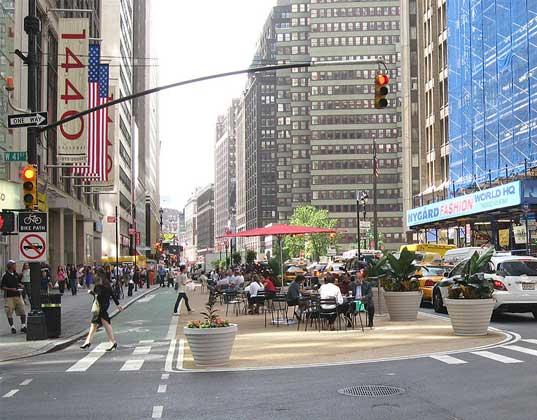 http://inhabitat.com/new-york-city-asks-residents-to-propose-more-pedestrian-walkways/....meanwhile, DeBlasio, could preside over a period of increasing deaths AND get his butt kicked by Albany because they perceive this all as a charade to raise tolls.Likewise, I look forward to seeing how compliant the police will be with DeBlasio's wishes once their contract is signed. Once the contract is signed, will "Vision Zero's" power over them be diminished?
 -
The numbers of deaths by year 2008-13:
2008-151
2009-155
2010-151
2011-142
2012-152
2013-156
Also, during this period I'm pretty sure overall traffic volume in NYC was decreasing (at least it appears that way from eyeballing the 2012 NYS Traffic Volume report). https://www.dot.ny.gov/divisions/engineering/technical-services/highway-data-services/traffic-data -
DOT just announced the launch of SBS on 125th St."Travel times expected to decrease by 20 Percent along the M60 route, connecting major job centers in Manhattan and Queens, including LaGuardia Airporthttp://a841-tfpweb.nyc.gov/dotpress/2014/05/m60-laguardia/
Expansion marks city’s seventh SBS line, building on Mayor de Blasio’s commitment to expanding the improved service across the five boroughs" -
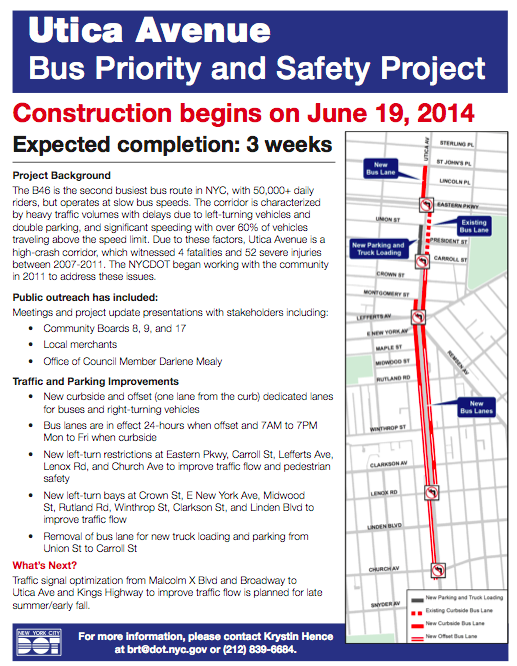
More info on the exact changes they'll be making on Utica
-
As time goes on, I expect the DOT and MTA to regularly say they are working together.
The speech will be "making it faster and safer for New Yorkers to get around".
I expect them to say the pending improvements on Utica are a success, to justify SBS lanes along all of Utica.
I am not opposed. -
Well, I just want to know which DOT employee is anti-left turns. Seems they are systematically trying to get rid of them off every major street in Brooklyn. First Flatbush, then Atlantic, now Utica.
Conspiracy by the right????? -
It is going to be difficult to give us NJ Jug Handles, given how packed in we are.
-
NJ style jug-handles were mentioned at the CB8 discussion in the context that w/no left turns allowed, each vehicle would have to negotiate three (3) right turns, replete with stopping at lights, traffic congestion, and double-parking on E51st Street (the block east of Utica Ave.) to mimic a simple left turn. Or going up to the next 'legal' left turn; either option increase the difficulty of driving, gas consumption, and air pollution. With all this considered the planning parties still see this as progress. The SBS will be rammed through. As noted previously in this thread, while SBS buses make travel faster, seniors and infirm persons who can't walk the distance between express stops have noted wait times for a local bus as long as 40 minutes.




Howdy, Stranger!
Categories
- 40K All Categories
- 27.1K Neighborhoods
- 5.1K Crown Heights/Prospect Lefferts Gardens
- 7.1K Prospect Heights
- 2.3K Fort Greene, Clinton Hill, Bed-Stuy
- 8K Park Slope
- 549 Williamsburg, Greenpoint, Bushwick
- 442 Flatbush/Midwood/Ditmas Park
- 657 BoCoCa (Boerum Hill, Cobble Hill, Carroll Gardens)
- 151 Red Hook
- 104 Gowanus
- 304 Bay Ridge/Bensonhurst
- 130 Coney Island, Brighton Beach, Sheepshead Bay
- 270 Brooklyn Heights, DUMBO and Downtown
- 598 Windsor Terrace / Kensington
- 673 Greenwood Heights and Sunset Park
- 749 Brooklyn and Beyond
- 6.3K Stuff
- 86 Brooklyn Back When
- 1.2K Brooklyn Pets
- 257 Brooklyn Kids
- 241 Brooklyn Eats
- 51 Brooklyn Booze
- 3.6K The Lounge / Random Stuff
- 611 Brooklyn Politics
- 122 Brooklyn Sports and Fitness
- 111 Brooklyn Photos
- 339 Site Issues
- 8 Frequently Asked Questions (FAQ)
- 6.2K Listings
- 1.1K APARTMENTS and REAL ESTATE
- 1.3K Sales Openings Events
- 2.3K The Classifieds