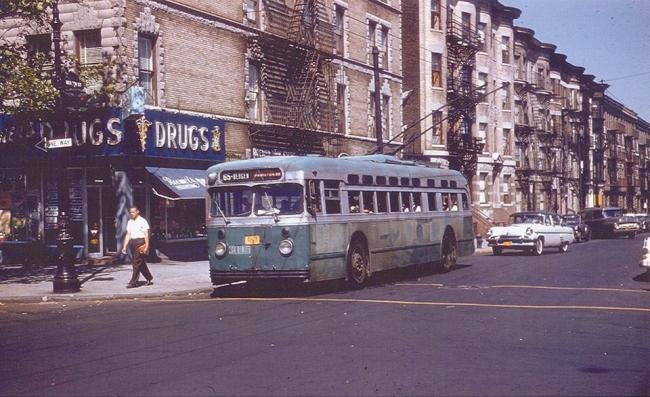
Bergen St and Bedford Ave, 1950s.

At the time, it was known as Bed Stuy.
Comments
-
Recently:
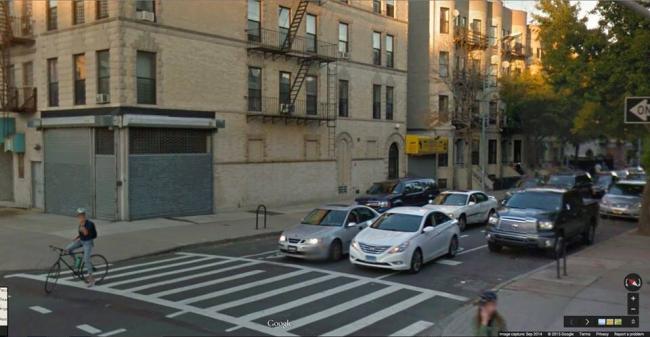
Photo's Al Ponte's time machine -
Bed-Stuy (Bedford-Stuyvesant) was as the name implies, the area bounded by Bedford Avenue on the west, Stuyvesant Avenue on the east, Fulton Street on the south, and bounded by Broadway on the north.
It became slightly less rigid, and the eastern border extended in some parts to what is now Boyland.
If you check the late 60s and early 70s, part of the area claiming to be Bed-Stuy was Ocean-Hill Brownsville.
.
Bergen Street and Bedford Avenue was definitely not Bed-Stuy.
-
One thing that saddens me about this is the removal of the cornices on the top of the buildings.
-
A friend points out that the condition of the bus pretty accurately correlates with public transportation having almost exclusively poor riders in the 1950s.
@bklyn50 I like Map 4: http://urbanology.org/bedstuy/
...your map is there too.
-
I.M. Pei likewise believed that Prospect Place between Kingston and Albany was Bed-Stuy in 1968:'Bed-Stuy' is/was probably more of a metonym for 'Black Brooklyn' than an actual piece of land, as Harlem is/was in Manhattan.
-
I.M. Pei likewise believed that Prospect Place between Kingston and Albany was Bed-Stuy in 1968:
Yes, I.M. Pei would say something like this, being a voice of the wealthy in the 60s.'Bed-Stuy' is/was probably more of a metonym for 'Black Brooklyn' than an actual piece of land, as Harlem is/was in Manhattan.
I remember reading an article in the NYTimes magazine section. It spoke of a crime being perpetrated, and identified the perpetrator, who lived on Ocean Avenue along Prospect Park, as coming from the Bedford-Stuyvesant section of Brooklyn
This just goes to the meme that "history" is HIS STORY.
The people who lived there are continually ignored when they describe who and what they are.
fyi
A metonym
is a figure of speech used in rhetoric in which a thing or concept is
not called by its own name, but by the name of something intimately
associated with that thing or concept. For instance, "Westminster", a
borough of London in the United Kingdom, could be used as a metonym for
its government.
-
As whynot_31 tangentially alludes to, the link to "urbanology" has three maps within a doctoral thesis done about central Brooklyn, One of these maps DOES include eastern Crown Heights as part of Bed-Stuy. The map was credited to the Bedford Stuyvesant Restoration Corp. (BSRC), which was largely funded thru the efforts of Robert Kennedy. BSRC is to be credited with the creation of the two (2) "super-blocks", St. Marks Avenue and Prospect Place, both between Kingston and Albany Avenues. BSRC was lead by (and might still be) Colvin Grannum, Esq. Mr. Grannum, at some time, lived on Bergen Street, between Brooklyn and NY Avenues, possibly explaining why parts of eastern Crown Heights were included in the framework of the BSRC.
-
Yup. Such catchment areas tend to stick.
For example, on occasion, I write proposals for non-profits. Many of the non-profits seek funding that is closely tied to race/language/etc.
Once a given non-profit secures the funding for a given service, other non-profits are effectively shut out of the zip code or census track.
Thus, in the minds of funders (government, foundations, etc) an area becomes defined.
Perhaps needless to say, the funding tends to further the growth of the population niche because people tend to seek culturally and linguistically competent services.
This map from CPC depicits the phenomena well: https://cpc-nyc.org/locations
Arguably, BSRC used to be a more powerful force than CPC is today. -
Was the area called so because it was originally Stuyvesant's farm that extended to eastern parkway?
-
I doubt you will get a definitive answer that the historians agree on.
People have been calling the same area different names since the beginning....
And people have been insisting that their name is exclusively correct.
We seem to agree only that the sun rises in the east and goes down in the west.



Howdy, Stranger!
Categories
- 40K All Categories
- 27.1K Neighborhoods
- 5.1K Crown Heights/Prospect Lefferts Gardens
- 7.1K Prospect Heights
- 2.3K Fort Greene, Clinton Hill, Bed-Stuy
- 8K Park Slope
- 549 Williamsburg, Greenpoint, Bushwick
- 442 Flatbush/Midwood/Ditmas Park
- 657 BoCoCa (Boerum Hill, Cobble Hill, Carroll Gardens)
- 151 Red Hook
- 104 Gowanus
- 304 Bay Ridge/Bensonhurst
- 130 Coney Island, Brighton Beach, Sheepshead Bay
- 270 Brooklyn Heights, DUMBO and Downtown
- 598 Windsor Terrace / Kensington
- 673 Greenwood Heights and Sunset Park
- 749 Brooklyn and Beyond
- 6.3K Stuff
- 86 Brooklyn Back When
- 1.2K Brooklyn Pets
- 257 Brooklyn Kids
- 241 Brooklyn Eats
- 51 Brooklyn Booze
- 3.6K The Lounge / Random Stuff
- 611 Brooklyn Politics
- 122 Brooklyn Sports and Fitness
- 111 Brooklyn Photos
- 339 Site Issues
- 8 Frequently Asked Questions (FAQ)
- 6.2K Listings
- 1.1K APARTMENTS and REAL ESTATE
- 1.3K Sales Openings Events
- 2.3K The Classifieds