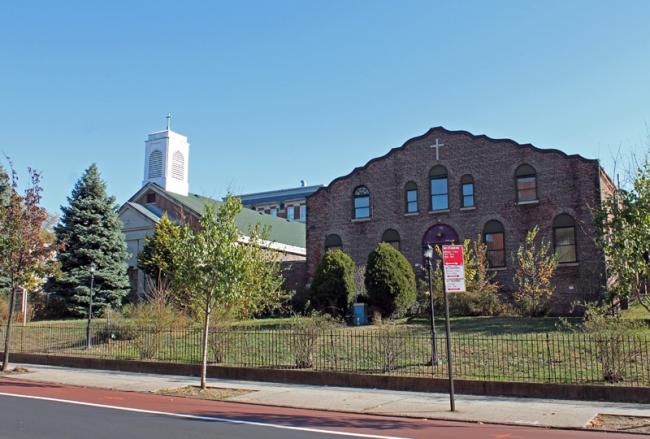
South of EP: The church at Rogers between Carrol and Crown is torn down. Residential on the way
Comments
-
I wish they'd start later in the day. So bloody loud. I think they're behind schedule and are rushing to get done by the Fall of 2015. I haven't seen a construction site speed along this quickly. Perhaps the Vatican coffers needs the rent money to pay of the priestly sins.
-
A few people have told me that the Catholic church continues to own this property, and has leased it to the developer on a 99-year "front loaded" lease.
If true, this arrangement might allow the developer to escape many real estate taxes and allow the Catholic Church to put a new church on the property in 2114.
....This might be about the time that its present rebranding takes hold.
-
Very few things can stop an As Of Right development.
-
oh, yeah, they're delusional--this building is obviously happening. but calling attention to the seedy tax deal has to count for something, right?
-
No.
99 year leases with churches are legal. This property is far from unique.
http://www.dcgrealestate.com/blog/dcg-blog/faith-based-organizations/are-church-leases-with-commercial-developers-the-new-money-machines/
https://www.bostonglobe.com/metro/2015/02/16/church-tries-commercial-development-leverage-high-value-real-estate-south-end/OCHELYB89xXATBAyYBoECI/story.html
Usually a developer is only able to avoid paying property taxes in exchange for making a % of the units rent stabilized. By leasing from a church, developers can avoid paying taxes without incurring this obligation.
....making those properties quite valuable and tying the hands of government. -
What happens to the building after 99 years? The church takes ownership and becomes the landlord?
-
Or, leases the property again.
Or, sells it.
etc.
We should remember that the value of the building may be exhausted by then; They don't build buildings like they used to.
My favorite part of this dynamic is that (in addition to gov losing out on taxes) the NYS SLA does not take into account whether a building is owned by a religion, only whether it is "occupied" by one.
So, bars and restaurants wanting to locate near this building are not constrained by the rule that prohibits full liquor lics within 200' of said building.
As a result, neighboring commercial properties are not excluded from such profitable uses, AND benefit from the church continuing to own the property. -
It's interesting that on this board and in other places on the internet, the story of Crown Heights having been a black neighborhood "only for the last 30-40 years" is repeatedly parroted. Somehow the fact that the neighborhood was gentrified over the course of the first half of the 20th century and the black residents living here pre-gentrification literally carved a neighborhood out of the woods is conveniently forgotten. I guess twenty years from now, I can look forward to being asked "What are you doing in this neighborhood?".
-
If you lived on Vanderbilt Ave in Prospect Heights you didn't have to wait 20 years.
Use the Brooklyn map to toggle between 2000 and 2010, and watch it turn blue.
http://www.urbanresearchmaps.org/plurality/blockmaps.htm
If they were to update it to 2015, I imagine it would be a deep blue by now. -
Per Wikipedia:
Crown Heights had begun as a posh residential neighborhood, a "bedroom"[clarification needed] for Manhattan's growing bourgeois class. The area benefited by having its rapid transit in a subway configuration, the IRT Eastern Parkway Line (2 3 4 5 trains), in contrast to many other Brooklyn neighborhoods, which had elevated lines. Conversion to a commuter town also included tearing down the 19th century Kings County Penitentiary at Carroll Street and Nostrand Avenue.[9]
Beginning in the early 1900s, many upper-class residences, including characteristic brownstone buildings, were erected along Eastern Parkway.[why?] Away from the parkway were a mixture of lower middle-class residences. This development peaked in the 1920s. Before World War II Crown Heights was among New York City's premier neighborhoods, with tree-lined streets, an array of cultural institutions and parks, and numerous fraternal, social and community organizations.
Population changes began in the 1920s with newcomers from Jamaica and the West Indies, as well as African Americans from the South.
From the '40s through the '60s, many middle class Jews lived in Crown Heights. In 1950, the neighborhood was 89 percent white, with some 50 to 60 percent of the white population, or about 75,000 people, being Jewish, and a small, growing black population. By 1957, there were about 25,000 blacks in Crown Heights, making up about one-fourth of the population.[10] There were thirty-four large synagogues in the neighborhood, including the Bobov, Chovevei Torah, and 770 Eastern Parkway, home of the worldwide Lubavitch movement. There were also three prominent Yeshiva elementary schools in the neighborhood, Crown Heights Yeshiva on Crown Street, the Yeshiva of Eastern Parkway, and the Reines Talmud Torah. -
From the Vice article posted above:
The prison ledger presents no record of the convicts' race, only their names and towns of residence (nearly all of them were from Brooklyn). What is known is that at the time, Crown Heights was called Crow Hill, a name some sources attribute to the birds that settled on the hill, but the derivation of which likely lies in the neighborhood's robust black population at the time ( crow was a slur for black people that originated in the early 1800s—hence "Jim Crow"). An 1873 Brooklyn Daily Eagle unearthed by the Brooklyn Public Library quotes a white policeman responding to the question, "How did their settlement get to be named Crow Hill?" by saying, "Well, they had to live away from the white people, and they got up there in these woods. The woods were at the time full of crows, and it was called Crow Hill, partly because there were a great many crows there and partly on account of the people nicknaming the darkies 'crows,' too."
This was a black community as far back as Reconstruction. Crow Hill, Weeksville and other smaller settlements were all thriving communities with some settlements in the area dated back to the Revolutionary War.
-
When a fortunate group (often a mix of race and religion) leaves a neighborhood, they often leave signs that they were there in the form of institutional buildings.
Jewish people leave temples, some of which are then often converted to christian churches, but still easily identified as former synagogues. The Brooklyn Jewish hospital complex is now apartments.
White Catholics leave behind big parish complexes, which often include high schools (such as St Theresa Complex, or the School for the Deaf on Eastern Parkway). These buildings live on as non-religious schools, and/or new congregations.
In other instances, only a few restaurants and bars remain as a testament to the past.
Richard Hurley and Maria Molina (see article) were each speakers on the 2015 walking tour that Ms Whynot and I led, and fear no trace of "them" will be left behind.
Only the obscure Weeksville Heritage Center will remember them.
-
i don't think anyone denies that crow hill was an important phase in crown height's history...it just happened a much, much longer time ago than the changes that happened in living memory, of which there were many even in just the past 50 years.this stretch of rogers might see many waves of changes before the 99 year lease is up....and by then it'll be crumbling ocean front property.
-
They are in the process of pouring the 4th floor. One more to go.
These photos don't show it well, but the interior courtyard will be large and provide lots of light. Almost like a private park.
-
The building has now reached its terminal height


-
Workers have been busy installing metal partitions for the windows and interior walls.


-
-
Shot taken today indicates much of building is now enclosed.

-

-
Ugh. Another beautiful architectural structure torn down to build a pricey, grey rectangle.
-
That street feels SO much darker now when you walk down it.
-
Yup.
The building is now fully enclosed, and developers are often able to get buildings ready for occupancy with in 6 months after that milestone.
So, this building is likely to lease in the late Fall 2016.
-
This site continues to be one of the sites I believe will make a large impact on western Crown Heights: http://www.brooklynian.com/discussion/47007/the-big-18-developments-the-whynot-31-wont-stop-talking-about?new=1
-
Yellow brick facade now being installed. Rough electrical and plumbing appears near complete.
Completion late Fall, at the earliest.

-
Brick facade now almost complete




Howdy, Stranger!
Categories
- 40K All Categories
- 27.1K Neighborhoods
- 5.1K Crown Heights/Prospect Lefferts Gardens
- 7.1K Prospect Heights
- 2.3K Fort Greene, Clinton Hill, Bed-Stuy
- 8K Park Slope
- 549 Williamsburg, Greenpoint, Bushwick
- 442 Flatbush/Midwood/Ditmas Park
- 657 BoCoCa (Boerum Hill, Cobble Hill, Carroll Gardens)
- 151 Red Hook
- 104 Gowanus
- 304 Bay Ridge/Bensonhurst
- 130 Coney Island, Brighton Beach, Sheepshead Bay
- 270 Brooklyn Heights, DUMBO and Downtown
- 598 Windsor Terrace / Kensington
- 673 Greenwood Heights and Sunset Park
- 749 Brooklyn and Beyond
- 6.3K Stuff
- 86 Brooklyn Back When
- 1.2K Brooklyn Pets
- 257 Brooklyn Kids
- 241 Brooklyn Eats
- 51 Brooklyn Booze
- 3.6K The Lounge / Random Stuff
- 611 Brooklyn Politics
- 122 Brooklyn Sports and Fitness
- 111 Brooklyn Photos
- 339 Site Issues
- 8 Frequently Asked Questions (FAQ)
- 6.2K Listings
- 1.1K APARTMENTS and REAL ESTATE
- 1.3K Sales Openings Events
- 2.3K The Classifieds